Thursday, February 24, 2022

You Too Can Explore A Real Asteroid!

So here is the database for the curation of the pebbles/grains/dust that Japan's Hayabusa2 space craft BROUGHT BACK under hermetically sealed conditions from asteroid Ryugu last year.

https://darts.isas.jaxa.jp/curation/hayabusa2/


you can download a pic of each under magnification.  also it seems you can borrow them?  god knows what kind of qualifications you need for that, but researchers obviously borrow them to study, maybe make microslices and analyse them.

it begins.  they look like some kind of slaggy crumbly dusty coal.  they may be of similar structure, though not from biology but from interstellar processes and early solar system processes.  they also look like they WOULD NOT survive entry into our atmosphere as meteorites (even if they were larger peices)  my gut tells me we don't have meteorties like these.  But I need to look up what we've learned about them so far.

Basically this is stuff left over trom the origins of the solar system.  These things formed maybe near the asteroid belt.  Closer in... pebbles formed with more rock and iron (like earth).  Further out things formed with more ices (water, methane, carbon dioxide, ammonia...)  But there was much mixing and then more mixing and processing quickly after formation.  Japan and I think NASA has previously only brought back a tiny bit of DUST particles from an asteroid or comet.

Of course we have brought back many pounds of moon rock, but they are rock and geologicaly processed, not from the beginings of the solar system.  We also have tons of meteorites of many types of origins, but the delicate ones like Ryugu stuff, is very altered by its passage through our atmosphere.  We also have a couple dozen chunks of rock that got splashed off of mars by big meteorites hitting mars, and landed here as meteorites.  except for one, they are all young and heavily processed by mars geology.  We also have

i remember when hayabusa2 sent bouncing robots to explore the asteroid's surface they decided that the rocks they were bouncing on were NOT very strong.

https://en.wikipedia.org/wiki/162173_Ryugu

 In a few years,  NASA's Osiris Rex will return more samples (perhaps more and larger than these) from a similar asteroid it also visited, called Bennu. I don't know why O-Rex is taking longer!


If I had the presence these days... I'd write REAMS about this stuff.  Actually... I'd learn more too.

Thursday, February 17, 2022

Why Do I Do Natural History? (my 3rd exercise, one night, when I had to teach myself to write an essay for an exam)

Each year I try to learn about a group of plants or animals that I haven't learned much about yet.  Last year it was aquatic plants, this year it's spiders.  

What I do is I get some books about the group, about how they live, how to find them, and some technical field guides which tell me how to identify them to species.  The latter part is often difficult and requires using tools like a dissecting kit, and microscope or at least hand lens and developing odd technical skills.  

Then I go outside and find, observe and (sometimes catch) and analyze the critters.  Why, you may ask, do I go through this each year?  It is not my profession!  Well, there are intellectual, aesthetic and ultimately spiritual reasons.


One of my main intellectual interests in life is how the universe keeps evolving to more and more complex forms.  I may even go back to school and study the mathematics and physics of this.  

Differentiating between this species and that, often involves counting and noting the positions of spines or looking at microscopic features of the beasts.  That activity really puts me in touch with how complex they really are and keeps me asking "How?".  "How does simple chemistry become living cells that can produce all these hairs?  How do all those cells arrange themselves to make a jumping spider that can find and catch another insect?"


The easy reason why I do this of course is that these plants and animals are absolutely beautiful once you take the time to look at them.  Jumping spiders?  those big puppy eyes and furry paws they have!  And then the sheer delight at watching one stalk and pounce on its prey.  

On a larger scale, the more kinds of plants and animals I learn to see, the more richly textured I see my landscape.  At one time I learned to identify over 500 different kinds of plants in my state and at first I thought this level of analyticity would destroy my gestalt sense of beauty, every time I took a walk, recognizing this plant, that plant, hundreds... But in the end, it just increased the depth of the texture of what I saw.

And then knowing how each critter lives helps me see how interconnected that dense texture is, how it functions like an organism itself.  This to me is beautiful.


Finally, I don't go to exotic lands to do this, I find these critters in my own landscape, around my house, in a seemingly ordinary crack in the sidewalk, or within walking distance or a bike ride.  It helps me feel connected to where I live.  It helps me feel that my home is alive.  And that it is wild, not concerned with the petty human rat race.  

When I get down with that jumping spider and watch it closely enough to count whether there are two or three pairs of spines on the "ventral side of its front metatarsi...", and begin to imagine how he uses them to capture his prey... and I've lost myself for an hour.  

I really immerse myself in the wild landscape and forget this petty human drama.  Ultimately in my natural history excursions I loose myself and become whole.

Thursday, December 30, 2021

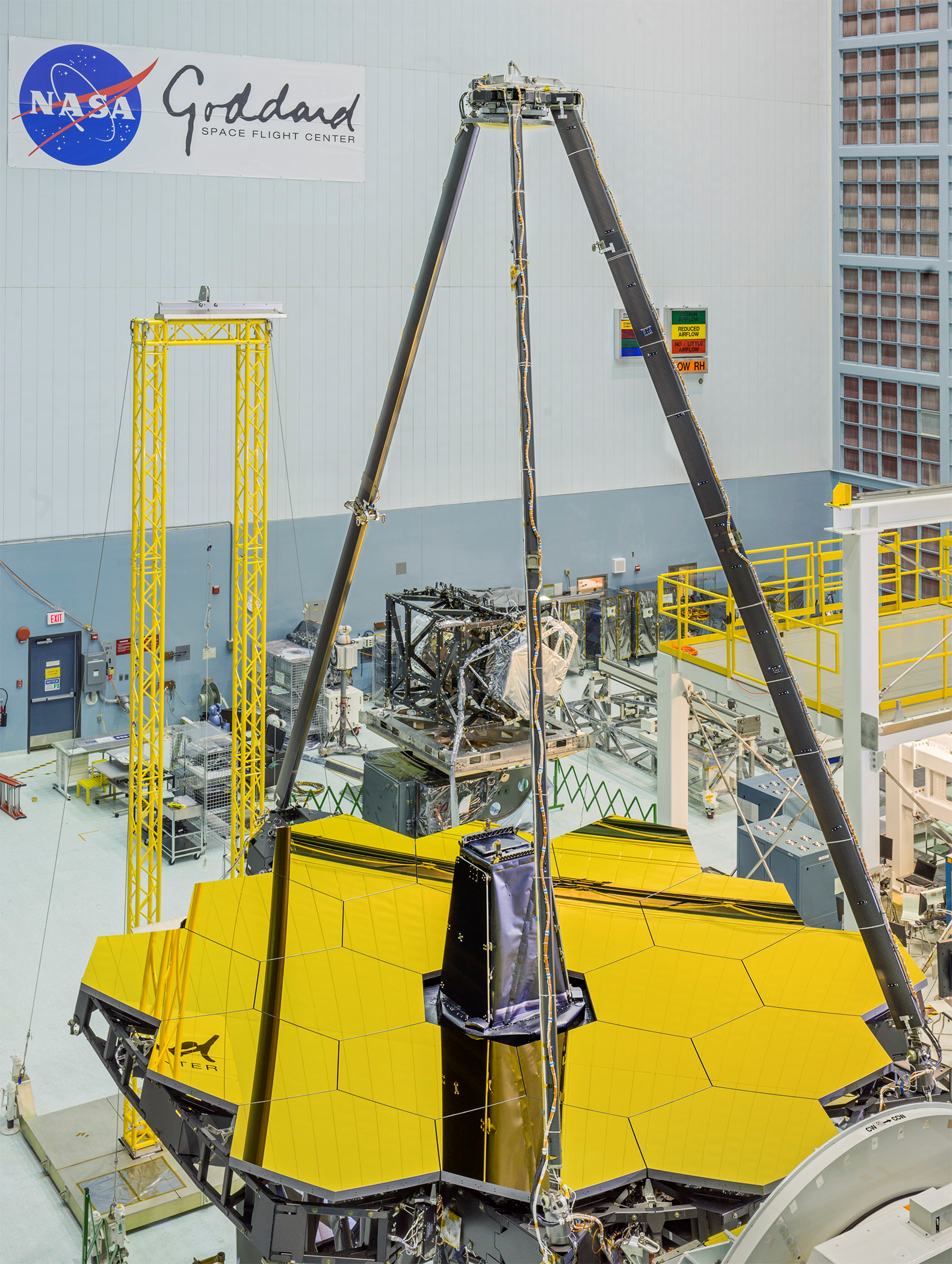
NASA so far succeeding in horrendously complex process of unfolding their new telescope in space

 I think there are 600 discrete steps or so.  it's a monstrous thing and had to be so folded up tightly into the rocket to get up there... i'm outside so my hands might be too cold to type in a description.

here is photo of the 5 sunshields unfolded for testing, messy delicate
https://bestgamingpro.com/james-webb-space-telescope-unfolds-its-sunshield-in-test/


here is photo of 18 segment primary mirror and secondary focus mirror way up there all unfolded
https://www.sciencealert.com/nasa-just-unveiled-the-james-webb-space-telescope-s-huge-golden-mirror


i dont think theyve ever had EVERYTHING unfolded at once

here it is all folded up for putting into space capsule


here is animation of unfolding sequence
https://www.youtube.com/watch?v=6RcMfAAiGFI

here is NASA webpage showing what stage of unfolding we are at currently
https://webb.nasa.gov/content/webbLaunch/deploymentExplorer.html

we are at step 12!

this nasa we blog keeps us up to date

https://blogs.nasa.gov/webb/

then we have to get to it's orbital position and then we have to wait months for it to get really cold!  it needs to get cold because it is not a visible light telescope, it sees in infrared (radiant heat, subtle radiant heat from billion light years away galaxies.)  so just like you gotta keep stray light away fromm telescope at night, we gotta keep stray heat away from james webb telescope.  so we cool it to 100s degrees below zero and shade it from sun AND earth. that's what the 5 sunsheilds are for.

what will we see?  galaxies way way close to the begining of the universe.  star formation, and ATMOSPHERIC CHEMISTRY of planets around OTHER stars!  and things we haven't yet dreamed of.

good luck


Thursday, October 28, 2021

Beavers at Fitzgerald Pond

 
after trying to get him to splash, i figured out that he'd do it if i clucked at him.  curious bloke he kept coming closer to look at me.  I think there is a family of them.  of course i forgot to take a picture of their lodge.  maybe today.


Tuesday, August 24, 2021

Finally Looked Up A Cool New Lichen I Found: Lecanora thysanophora

 Ok i finally looked up a lichen i found a few months ago in the woods on the way to arcadia park off the bike trail to easthampton ma.


Lecanora thysanophora, cool structure, i should get it under the scope and see what on earth it is doing. watching it grow wld be cool too.

I don't know why it grows that outer band of white fibers. the mealy center portion is where it comes apart in tiny bits to blow around to new tree trunks to grow on. These guys don't seem to be having any sex. I think this species rarely does.  Many lichens DO have sex.  In the pics of species from waysofenlichenment you see many with rimmed dots.  those are where two separate fungi critters are intertwined, having sex and making spores to blow off in the wind.


Remember, being a lichen, this critter isn't eating the bark or digging into the tree, it's just resting there letting it's internal captured single celled algae (Trebouxia) grow food for it from the air and sunlight.
 
Lecanora is a rather diverse genus, you have no doubt seen it. grows on wood and rock and stone walls.
 
(my photos)


https://www.waysofenlichenment.net/lichens/Lecanora/
 
oh by the way... those reddish crisscrossy veins... are a liverwort. i should make a post for them too eh? Frulliana species. here's some from underneath under the microscope. 


and here's a pic of one of their fruiting bodies springing out spores with their springy thingies. 


Wednesday, August 11, 2021

How long does it take light to travel around the solar system? Story and Experiments

A twitter Kindergardener asked how long it takes for light to travel to us from the sun, so I gave her mom some ideas.

Here is what she can do:  so pick something to bang together and she can hear it instantly, now walk maybe a couple hundred feet away (500? 1000?) i think it works with couple hundred and bang.

She should be able to notice it looks and sounds funny cuz the there's a delay between seeing you banging and hearing it.  There's the clue that sound actually takes time to travel to her.  Now for more fun:

When people discoverd 100s of years ago that Jupiter had moons, they realized they could use them like a clock, cuz they went round and round very regularly like the hands of a clock, (slower!) and so people started making tables of what times the moons would appear when!

Back then... clocks didn't work so well on sea going sailing ships and people hoped they could use Jupiter and a small telescope at sea, as a clock!  By consulting the tables.  But problems occured...

At some parts of the year the Jupiter moon clock ran behind!  About 20 minutes behind!  But some observant astronomers (like your daughter...) remembered hearing how funny it was when people bang on things far away and you hear a delay in the banging, cuz sound takes time to travel, so

they realized just like the delay in far away banging things, they SAW a delay in the jupiter clock hands when jupiter was FURTHER away from us, and so they reasoned that light itself took time to travel!  About 17 minutes from jupiter to earth.  This was an amazing discovery because seeing, light, seemed to be INSTANTANEOUS!  

And since Jupiter is REALLY far,

that means light is REALLY fast.  From banging far away you could probly, time the delay and figure out sound goes about 1000feet in a second.  For the speed of light it took a little while to figure out how fast cuz we needed to know how much further earth was from Jupiter every 6 months:


Distances a LOT MORE than a 1000 feet!

Earth is 200 MILLION miles further from Jupiter when it is on the other side of the sun, so

200million miles causes 20 min delay, so the light is traveling

10million miles a minute

a million miles in 6 seconds

sixth of a million in second, about 150,000 miles a second!


Dunno how much of that you can translate for your daughter, but I hope you can try the experiment with her.  Maybe with 2 people you help her watch and time it and other person bangs!  I've never tried it. I'll try it with a neighbor and try to measure it and get 1000feet per second!

If your daughter ever gets a chance to look at jupiter in a small telescope (binoculars?) maybe with a local astronomy club or something... someone can point out Jupiter and some moons?

I remember the day I was watching someone banging with a hammer and noticing the funny delay and a lightbulb went off in my head and I understood this jupiter clock story!


Finally!  This story gives us the answer to her question!  Because by looking at the delay in the Jupiter clock, they figured out it took light 17 minutes to go across the orbit of the earth, from one side to the sun and across, so HALF of that is how long light takes to go from the sun to the Earth, about 8 and a half minutes!


Monday, July 19, 2021

Ok, I Have Found The Mites!

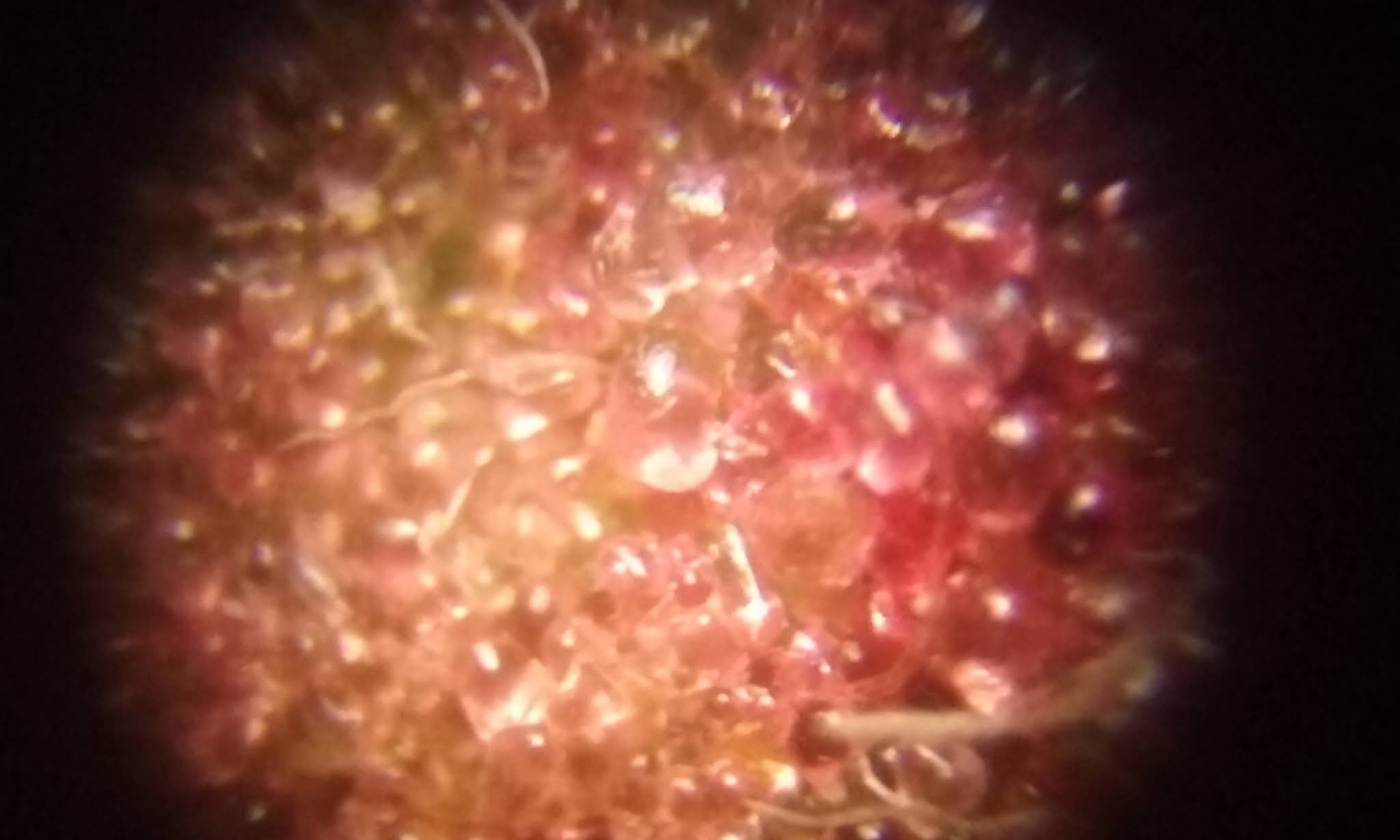
Caviar on a leaf?  So, a few weeks ago, I found what I thought was a fungus growing on some leaves.  I think they are growing on downy birch, (Betula pubescens)  I thought the fungus was not mature yet.  also I wanted to do thinner sections of the leaf to see if the growths were INSIDE the leaf tissue


The little pink blobs are about a 1/2 a millimeter high on the surface of the half a millimeter thick leaf.

Little hollow trumpets with pink blobs at the top.  What will they grow into?  dunno!  I can't tell if the fungal tissue is growing INSIDE the leaf.  can't see leaf cells niether!  need thinner section.  don't see any cells in the fungus either!  maybe is NOT a fungus.  Time will tell.

I could see hints of vascular tissue (tubes for water and nutrients, the plant's circulatory system) in the cross section tho.  each tube is one cell thick.


I think the large circles are cross sections of Xylem, the tubes that ship up water from the roots.  The Phloem, the tubes that the leaf sends food back down to the plant in, should be below.  


Well I soon found out that they were NOT fungus.  

What i thought was a fungus on the tree leaves, turns out to be the leaves reacting to being fed on by an Eriophyrid mite! Mites are related to ticks. some, you have seen, like these cute velvety red ones: about a millimeter long. u see them crawling everywhere even under water.  If you look under leaves and in rotting logs and in dirt you find tons of little round mites of all sorts...
 
from
https://en.wikipedia.org/wiki/File:Trombidium.spec.1706.jpg

 
most, you don't see, as they are much less than a millimeter and hide, like hair follicle mites, house dust mites or plant gall mites. 4000 kinds of those. feed on plants and the plants get annoyed and make Galls around them.
 
 
Anyway, I've been told that my purple/salmon blob 'fungus' on (probly) Downy Birch leaves is the leaves being disturbed by 1/5th of a millimeter long mites, Acalitus longisetosus
I will have to look at the leaves closely and find the mites! tho maybe they are only active spring and fall!


 Update: (18 March 2021) I found the mites!  Here's one crawling around in the purple blobs.
And here is a beautiful shot lit fro the side with dark backround of the mite scraped off of its leaf.  Mites in the family Eriophyidae only have 4 legs (most mites, like spiders, have 8).  Look at those beautiful bands going down the mite!  I guess it has long setoses...

HAHA!  my first parasitic mite discovery!  Now I am on to them.