Preliminary discussion and experiments:
Question:
dripping drops into a pool of liquid. when you drip liquid A into a pool of liquid B, one drop at a time, you get a tiny splash upon impact.
Is the splash that you see a small amount of liquid B being flung into the air, or is it liquid A bouncing off of the surface of liquid B?
http://sfbay.craigslist.org/forums/?ID=91386638
Blackskimmmer:
lets look:
maybe the website describes the experimental setup and we could use two immiscible fluids of different colors to find out?
cool pics of splashes:
http://courses.ncssm.edu/hsi/class2000/splashes/pictures2.htm
find the equations for this!
Blackskimmmer:
more pics and an article about bubbles in champagne:
http://courses.ncssm.edu/hsi/class2005/splashes/a/Balloon_Index.htm
http://courses.ncssm.edu/hsi/class2005/splashes/a/water_index.htm
http://www.europhysicsnews.com/full/13/article3/article3.html
Toober:
Perhaps a moving frame of reference
When I learned Navier Stokes as a chemical engineer, we always resorted to solvable boundary conditions within a static frame of reference (like a pipe wall, or sphere boundary, or rectangular channel). But I don't think that stasis is required. Or, another way to solve it is to treat the drop as a Newtonian sphere yet allow for "differentiable" elastic liquid smearing at the surface of impact. That's the ticket.
2)
well, my personal observation of dripping half-n-half into a cup of black coffee, is that the splash is white.
3)
iamlucky13:
Here's an example
First of all, yes these are real. It's from a photo contest site I sometimes browse. The photographer spent hours setting them up.
The ones to check out are the milk drops into coffee. You can see some mixing in the center column, but the outer edges appear to be mostly milk, suggesting that the milk drop rebounds against the coffee.
http://www.dpchallenge.com/portfolio.php?USER_ID=52549&collection_id=20111
iamlucky13:
Oops...correction
Reading her comments in a the "Octopus" photo, it sounds like the white milk umbrella forms when a second drop impacts the rising coffee column from a previous drop.
So the splash appears to be mixed coffee and milk.
4)
Blackskimmmer:
my results: mixing
water into soy milk from 6" to a foot, white spikes a cm or so
soy milk into water from ditto white spikes a cm or so
soy milk into olive oil from a foot, really viscous white blobs (the olive oil was in a 2cm deep bottle cap
olive oil into soy milk 6" to a foot, white spikes a cm or so
well, use imagination and interpret results. some mixing or at least the matrix fluid is clinging to the surface of the dropped fluid as it bounces back out.
this is fun, i'll try more variations when i get some time
Thursday, January 6, 2011

Why Does Water Stay In The Straw With Your Thumb Over It?
Preliminary discussion and experiments:
Hydrogyrophage:
Question (possibly leading)
You know that straw trick where you stick a straw in your drink, put your finger over the top of it, and pull the straw out of the drink so your straw is now full of water? And then you remove your finger, and all the liquid falls out.
As I understand it, the liquid doesn't fall out while your finger is there because to do so, it would pull a vacuum in the space between your finger and the liquid.
But if you tried this in a vacuum, doesn't that change it? If you're already in a vacuum, then you can't create more vacuum, so there should be nothing stopping the straw from allowing the vacuum to form between finger and liquid.
[...]
http://sfbay.craigslist.org/forums/?ID=158772545
1)
Blackskimmmer:
i thought it was surface tension at the bottom that holds the water in place.
do some simple experiments, try it with longer and wider straws.
after a certain width the lower surface breaks and the water spills out, no?
ditto with a longer straw? the weight of the water above the lower surface will break it?
now do i have any tubing to try this with? now i'm not so sure about a longer straw...
maybe there is also the interface between the water and the straw that is holding the water in there.
Kenguy119:
You're a genius
I was thinking about this after my initial reactive post. And was thinking the real culprit is surface tension. What I was thinking was what if the straw was 3 ft in diameter. No way it would hold. Since a park is being built near by there was some waste PVC. I tried my experiments and I couldn't get water to stay in anything with a diameter of larger than .5 in.
I liked your strait forward logical approach.
Blackskimmmer:
wait, simpler experiment, try it with soap in the water. or another fluid with less surface tension.
now where is that staw...
Blackskimmmer:
HA experiment rules! just tried it, made a staw
out of a pen, got the water in it.
touched the bottom with my finger, nothing
touched it with water, nothing.
touched it with dish soap, boom! half of it poured out till it reached half way up the straw, where there was no longer soap and a miniscus formed again
Hydrogyrophage:
I know that surface tension plays a part, but not the whole part. Otherwise, removing your finger at the top wouldn't cause the water to fall. Also, bulb pipettes would never work.
Blackskimmmer:
ok, did you see my post above? the next peice of teh puzzle is when you said the water doesn't fall cause you can't make a vacuum between the water and your thumb. but if the collumn of water is more than about 30 feet (at which the weight of the water is = to the weight of the atmosphere of similar cross section) the water DOES fall, and DOES leve a vacuum
Blackskimmmer:
ok, so further experimentation with my straw (4" long by 1/4" inside diameter) shows that when i lift my finger, surface tension WILL keep the water in the straw if the collumn is about 2 or 3mm high. that's the extent to the force due to surface tension.
it's confusing. with the finger, atmospheric pressure holds the water up, but only if the surface tension is there. once i break it, the interactions at the lower surface become complex and...
[...]
Hydrogyrophage:
Now this is EXACTLY what I was getting at!
Atmospheric pressure HAS to play a role in siphons.
Surface tension definitely works to counteract gravity to some extent (see capillary action), but it also plays a role in preventing air from moving through the liquid to the top.
I wonder if the water in your experiments isn't forming bubbles when you add the soap, which move to the top and allow the water to fall without pulling a vacuum.
Blackskimmmer:
thinking about the geometry and the forces at the surface of the water with or without soap gave me a headache. maybe i'll think about it some more.
the surface tension allows the atmospheric pressure to act on the entire surface as a whole, i.e. the lower surface essentially becomes a rigid membrane. and thus the atmospheric pressure can exert its force on the entire column.
when i shake the tube when the surface is convex out, a drop will pinch off, and the surface will reform, flat or concave in.
if i shake it some more a bubble will form and will rise a certain distance, which i suppose means that the collumn of water above it is sinking a distance of the thickness of the bubble. it then usualy stops half way up the tube and gets stuck! maybe at this point the collumn of water above it is not heavy enough to exert enough force to move it and surface tension/adhesion holds it in place?
another puzzle. even with a column of air above a column of water, the water does not spill out. it's got atm pressure below pushing up. but what's the presure in the collumn of air above? i don't have the tools with which to measure it.
even if there is just a bubble, i don't know if the volume of air forming the bubble gets expanded i the formation of the bubble thus lowering the air pressure inside the bubble.
it's all very confusing.
It's still confusing to me when you use the phrase "pulling a vacuum"
2)
Kenguy1192:
For the Straw: A vacuum makes no difference. It isn't a pressure differential that is keeping the water "up" It is the seal (and therefore closed system) between the fluid, straw, and your finger, that prevent a bigger vacuum.
Hydrogyrophage:
Now explain that one to me...
What scientific principle keeps the liquid from falling?
Can we draw a force diagram? What is acting on the liquid to counteract the force of gravity?
FWIW (probably not much), Wikipedia claims that atmospheric pressure plays a part.
Blackskimmmer:
force diagram... it's a fluid.. but, mg for the mass of liquid, down. air pressure times cross sectional area pushing up. now the complicated part: at the miniscus: it's i don't know what shape.. but it ISN'T horizontal! so that leads me to beleive that mg of the water is pushing down on it, and then there is the surface tension pulling with horizontal component towards the wall of the straw and vertical component up.
Blackskimmmer:
better observation: for my 4" water column in ~1/4 in. inner diameter plastic straw, i can make the bottom surface of the water convex, flat or concave.
that's curious. wait, that's with air between the top of the water and my thumb...
more experiments:
so i immerse the straw and my thumb in teh glass of water: pull it out and no space between top of water and my thumb. the miniscus is convex, bowing downward.
i shake it a little and a drop of water comes off, miniscus horizontal.
shake it again, and teh miniscus goes concave into the straw.
shake it again and another drop of water comes off and a BUBBLE sloooowly rises up the straw till it reaches finger, and now there's a region of AIR between the top of the water and my finger.
but the water STILL doesn't pour out! hmm what's the miniscus at the top look like?
lets see..
Blackskimmmer:
straw too cloudy at top to see, but here's something curious:
holding column of water in with finger at top.
shake it a little and drop of water comes out and bubble rises to the top of the collumn
shake it again and another bubble rises half way and gets STUCK in the column of water, so there is from top to bottom:
finger, thin layer of air, 2" column of water, 1/5" layer of air, 2" column of water!
Hydrogyrophage:
You missed it.
1) We can ignore the meniscus and surface tension forces. This is obviously not sufficient to keep the liquid suspended, as demonstrated when the finger at the top of the straw is removed.
2) My question is regarding this situation in a vacuum, so air pressure is NOT what is pushing the water upward to counteract gravity.
So what is?
Blackskimmmer:
i know, my answer is only part of your question... but wait, you at least read the results of my experiment? with the finger in place the water stays in the tube. when i destroy the surface tension with soap, the water pours out!
onward:
lets start here: if i raise the straw out of the water, mg in the column of the water is down. weight of atmosphere transmitted to the cross section of the straw at the surface pushes up.
the water does not fall while the weight of the water is less than the weight of the atmosphere above that column.
when you lift the straw up about 30 feet, finally the weight of the water IS greater and the higher you lift it, the water WILL fall, and WILL leave a vacuum below your finger.
this is why we invented steam engines to work at the bottom of mines. pumps at the surface could not pull water up when it was below 30 feet!
3) also, i failed to point out that probably with a THIN enough straw the water will probably stay in even with finger off. but now maybe adhesive forces between water and the walls plays a part? it's similar to my result of a 2-3mm tall column of water will stick in the tube with air above and below it and no finger holding top.
4) We also had discussion of why siphoning water with a tube from one bucket to a lower bucket works. It's related but adds MORE complications.
5) Important note from another discussion:
tminus7:
Rayleigh-Taylor instabilities.
http://en.wikipedia.org/wiki/Rayleigh-Taylor_instability
The real reason the water falls out of the tube.
Blackskimmmer:
why do you say these instablilties is why the water flows out of the tube? in the turbulent regime? or is it just what gets it initiating the flow?
tminus7:
It is what intiates the flow.
Remember the only reason we are talking about this problem at all is that the outside air pressure is pushing the water back into the closed pipe with more force than the water weight pusing out. This is the condition Of RT instability. A low density fluid, air, pushing on a high density fluid, water. The simulation picture in the wiki article, if you turn it upside down is, is exactly the OP's problem. This is for the pipe straight vertical.
One simple proof is the old playing card/ glass of water trick. Place a card over the open end of a glass of water. Hold it and invert the glass. Let go of the card and, magically, the water does not fall out! The card is a stiff solid and changes the conditions away from the RT condition. The card is not free to flow. But it shows the outside air pressure is great enough to hold the water (and card) in the glass. So gravity is insufficient to pull the water out of an inverted glass. You need RT to make it fall!
Hydrogyrophage:
Question (possibly leading)
You know that straw trick where you stick a straw in your drink, put your finger over the top of it, and pull the straw out of the drink so your straw is now full of water? And then you remove your finger, and all the liquid falls out.
As I understand it, the liquid doesn't fall out while your finger is there because to do so, it would pull a vacuum in the space between your finger and the liquid.
But if you tried this in a vacuum, doesn't that change it? If you're already in a vacuum, then you can't create more vacuum, so there should be nothing stopping the straw from allowing the vacuum to form between finger and liquid.
[...]
http://sfbay.craigslist.org/forums/?ID=158772545
1)
Blackskimmmer:
i thought it was surface tension at the bottom that holds the water in place.
do some simple experiments, try it with longer and wider straws.
after a certain width the lower surface breaks and the water spills out, no?
ditto with a longer straw? the weight of the water above the lower surface will break it?
now do i have any tubing to try this with? now i'm not so sure about a longer straw...
maybe there is also the interface between the water and the straw that is holding the water in there.
Kenguy119:
You're a genius
I was thinking about this after my initial reactive post. And was thinking the real culprit is surface tension. What I was thinking was what if the straw was 3 ft in diameter. No way it would hold. Since a park is being built near by there was some waste PVC. I tried my experiments and I couldn't get water to stay in anything with a diameter of larger than .5 in.
I liked your strait forward logical approach.
Blackskimmmer:
wait, simpler experiment, try it with soap in the water. or another fluid with less surface tension.
now where is that staw...
Blackskimmmer:
HA experiment rules! just tried it, made a staw
out of a pen, got the water in it.
touched the bottom with my finger, nothing
touched it with water, nothing.
touched it with dish soap, boom! half of it poured out till it reached half way up the straw, where there was no longer soap and a miniscus formed again
Hydrogyrophage:
I know that surface tension plays a part, but not the whole part. Otherwise, removing your finger at the top wouldn't cause the water to fall. Also, bulb pipettes would never work.
Blackskimmmer:
ok, did you see my post above? the next peice of teh puzzle is when you said the water doesn't fall cause you can't make a vacuum between the water and your thumb. but if the collumn of water is more than about 30 feet (at which the weight of the water is = to the weight of the atmosphere of similar cross section) the water DOES fall, and DOES leve a vacuum
Blackskimmmer:
ok, so further experimentation with my straw (4" long by 1/4" inside diameter) shows that when i lift my finger, surface tension WILL keep the water in the straw if the collumn is about 2 or 3mm high. that's the extent to the force due to surface tension.
it's confusing. with the finger, atmospheric pressure holds the water up, but only if the surface tension is there. once i break it, the interactions at the lower surface become complex and...
[...]
Hydrogyrophage:
Now this is EXACTLY what I was getting at!
Atmospheric pressure HAS to play a role in siphons.
Surface tension definitely works to counteract gravity to some extent (see capillary action), but it also plays a role in preventing air from moving through the liquid to the top.
I wonder if the water in your experiments isn't forming bubbles when you add the soap, which move to the top and allow the water to fall without pulling a vacuum.
Blackskimmmer:
thinking about the geometry and the forces at the surface of the water with or without soap gave me a headache. maybe i'll think about it some more.
the surface tension allows the atmospheric pressure to act on the entire surface as a whole, i.e. the lower surface essentially becomes a rigid membrane. and thus the atmospheric pressure can exert its force on the entire column.
when i shake the tube when the surface is convex out, a drop will pinch off, and the surface will reform, flat or concave in.
if i shake it some more a bubble will form and will rise a certain distance, which i suppose means that the collumn of water above it is sinking a distance of the thickness of the bubble. it then usualy stops half way up the tube and gets stuck! maybe at this point the collumn of water above it is not heavy enough to exert enough force to move it and surface tension/adhesion holds it in place?
another puzzle. even with a column of air above a column of water, the water does not spill out. it's got atm pressure below pushing up. but what's the presure in the collumn of air above? i don't have the tools with which to measure it.
even if there is just a bubble, i don't know if the volume of air forming the bubble gets expanded i the formation of the bubble thus lowering the air pressure inside the bubble.
it's all very confusing.
It's still confusing to me when you use the phrase "pulling a vacuum"
2)
Kenguy1192:
For the Straw: A vacuum makes no difference. It isn't a pressure differential that is keeping the water "up" It is the seal (and therefore closed system) between the fluid, straw, and your finger, that prevent a bigger vacuum.
Hydrogyrophage:
Now explain that one to me...
What scientific principle keeps the liquid from falling?
Can we draw a force diagram? What is acting on the liquid to counteract the force of gravity?
FWIW (probably not much), Wikipedia claims that atmospheric pressure plays a part.
Blackskimmmer:
force diagram... it's a fluid.. but, mg for the mass of liquid, down. air pressure times cross sectional area pushing up. now the complicated part: at the miniscus: it's i don't know what shape.. but it ISN'T horizontal! so that leads me to beleive that mg of the water is pushing down on it, and then there is the surface tension pulling with horizontal component towards the wall of the straw and vertical component up.
Blackskimmmer:
better observation: for my 4" water column in ~1/4 in. inner diameter plastic straw, i can make the bottom surface of the water convex, flat or concave.
that's curious. wait, that's with air between the top of the water and my thumb...
more experiments:
so i immerse the straw and my thumb in teh glass of water: pull it out and no space between top of water and my thumb. the miniscus is convex, bowing downward.
i shake it a little and a drop of water comes off, miniscus horizontal.
shake it again, and teh miniscus goes concave into the straw.
shake it again and another drop of water comes off and a BUBBLE sloooowly rises up the straw till it reaches finger, and now there's a region of AIR between the top of the water and my finger.
but the water STILL doesn't pour out! hmm what's the miniscus at the top look like?
lets see..
Blackskimmmer:
straw too cloudy at top to see, but here's something curious:
holding column of water in with finger at top.
shake it a little and drop of water comes out and bubble rises to the top of the collumn
shake it again and another bubble rises half way and gets STUCK in the column of water, so there is from top to bottom:
finger, thin layer of air, 2" column of water, 1/5" layer of air, 2" column of water!
Hydrogyrophage:
You missed it.
1) We can ignore the meniscus and surface tension forces. This is obviously not sufficient to keep the liquid suspended, as demonstrated when the finger at the top of the straw is removed.
2) My question is regarding this situation in a vacuum, so air pressure is NOT what is pushing the water upward to counteract gravity.
So what is?
Blackskimmmer:
i know, my answer is only part of your question... but wait, you at least read the results of my experiment? with the finger in place the water stays in the tube. when i destroy the surface tension with soap, the water pours out!
onward:
lets start here: if i raise the straw out of the water, mg in the column of the water is down. weight of atmosphere transmitted to the cross section of the straw at the surface pushes up.
the water does not fall while the weight of the water is less than the weight of the atmosphere above that column.
when you lift the straw up about 30 feet, finally the weight of the water IS greater and the higher you lift it, the water WILL fall, and WILL leave a vacuum below your finger.
this is why we invented steam engines to work at the bottom of mines. pumps at the surface could not pull water up when it was below 30 feet!
3) also, i failed to point out that probably with a THIN enough straw the water will probably stay in even with finger off. but now maybe adhesive forces between water and the walls plays a part? it's similar to my result of a 2-3mm tall column of water will stick in the tube with air above and below it and no finger holding top.
4) We also had discussion of why siphoning water with a tube from one bucket to a lower bucket works. It's related but adds MORE complications.
5) Important note from another discussion:
tminus7:
Rayleigh-Taylor instabilities.
http://en.wikipedia.org/wiki/Rayleigh-Taylor_instability
The real reason the water falls out of the tube.
Blackskimmmer:
why do you say these instablilties is why the water flows out of the tube? in the turbulent regime? or is it just what gets it initiating the flow?
tminus7:
It is what intiates the flow.
Remember the only reason we are talking about this problem at all is that the outside air pressure is pushing the water back into the closed pipe with more force than the water weight pusing out. This is the condition Of RT instability. A low density fluid, air, pushing on a high density fluid, water. The simulation picture in the wiki article, if you turn it upside down is, is exactly the OP's problem. This is for the pipe straight vertical.
One simple proof is the old playing card/ glass of water trick. Place a card over the open end of a glass of water. Hold it and invert the glass. Let go of the card and, magically, the water does not fall out! The card is a stiff solid and changes the conditions away from the RT condition. The card is not free to flow. But it shows the outside air pressure is great enough to hold the water (and card) in the glass. So gravity is insufficient to pull the water out of an inverted glass. You need RT to make it fall!
Friday, December 31, 2010
On R. Crumb's "The Book Of Genesis Illustrated"
http://www.amazon.com/Book-Genesis-Illustrated-R-Crumb/dp/0393061027
very dissapointing. He starts with an expansive epic text shimmering in mythic ambiguities, a text that counsels against pinning itself in fixed images. And then proceeds to pin it down with hundreds of tiny discrete literal images.
very odd. strange thing to see after so many years absorbed in the TEXT a text that says, no pictures! so many years in playing with the wordplay, the resonance between words that weave the text together. the poetry, the mythic qualities. the epic qualities.
on the illustrations: i was dissapointed with the pedestrian imagiinations with the text. when i read torah, i perceive mythic stories with epic proportion. after all it starts with the creation of the then known universe and the interaction with the creator of that universe...
when i read the text, which is extremely terse, which calls out for expansion, as indeed the rabbis through the ages expanded it in countless midrashes, reading between the lines, i too expand the stories. so it is dissapointing to see no expansion here. he illustrates exactly what is in the text, he does not extrapolate. he does not draw out the connections between the stories (and indeed the connections carry out between stories throughout the whole old testament!).
And of course the ultimate insult to the text, is a literal reading of it. As it is written, the text is incomplete, full of ambiguities, mere suggestions in so many places. and the purpose of the text, in the jewish tradition is that we are called to go with those hints, to create our own connections, extrapolations. the text cries out for it, and the tradition is seeped in this activity. It is holy. But Crumb's illustrations rather than preserving these ambiguities, pins them down in fixed graphics.
Language is a much more powerful medium for creating ambiguities, holding paradox, multiple viewpoints in the mind. It takes extraordinary efforts i.e. M. C. Escher and Picasso (and these are rather trivial cases) to do this in graphics.
one thing that really bothered me was that he wasted a LOT of panels just drawing faces showing various facial expressions in response to the text. instead he could have drawn images of what the text suggests, he could have drawn out the messages behind the text, the connections with other parts of the story, played on the poetry of the text, more of the mythic elements.
it's so focused on the individuals, petty human stories, but the individuals also clearly 'stand for' archetypes and peoples. Israel is at the same time a person and the whole people israel themselves. Adam is at the same time an individual (not much of one) and all humanity. Moab son of Lot is at the same time the whole people, the Moabites whith much future roles to play in the story ahead...
another point on the literalism of his illustrations: he draws god as a bearded old man. Now as Elohim, say in the first creation story, Elohim is clearly a force of nature and not a personality for humans to respond to. and even as yhvh, a much more personal presence that humans relate to... the point of tora is that yhvh is a voice, a calling, not an experience you can pin down in a picture.
there are plenty of instances for Crumb to draw, where god comes down as a messanger, i.e. when he comes to Abraham to announce he will have a child, and then argue with him about destroying Sodom.
I mean, you've got to build up to the point in Exodus where yhvh is clearly a monstrous volcanic force to be wrestled with, who does NOT even show his face, even to Moses.
In all, the text has always struck me as WAY bigger than Crumb draws it.
on the plus side, focusing as he does on the characters, i did come to some new excitiing realizations about what was going on with these characters. they made many messes of their lives and their children's lives. finally culminating in the reconciliation and forgiveness that joseph finally performs, closing the story. an interesting message. with larger closings as the old testament goes on, culminating in the reconcilation of Moab and Israel in the story of Ruth.
very dissapointing. He starts with an expansive epic text shimmering in mythic ambiguities, a text that counsels against pinning itself in fixed images. And then proceeds to pin it down with hundreds of tiny discrete literal images.
very odd. strange thing to see after so many years absorbed in the TEXT a text that says, no pictures! so many years in playing with the wordplay, the resonance between words that weave the text together. the poetry, the mythic qualities. the epic qualities.
on the illustrations: i was dissapointed with the pedestrian imagiinations with the text. when i read torah, i perceive mythic stories with epic proportion. after all it starts with the creation of the then known universe and the interaction with the creator of that universe...
when i read the text, which is extremely terse, which calls out for expansion, as indeed the rabbis through the ages expanded it in countless midrashes, reading between the lines, i too expand the stories. so it is dissapointing to see no expansion here. he illustrates exactly what is in the text, he does not extrapolate. he does not draw out the connections between the stories (and indeed the connections carry out between stories throughout the whole old testament!).
And of course the ultimate insult to the text, is a literal reading of it. As it is written, the text is incomplete, full of ambiguities, mere suggestions in so many places. and the purpose of the text, in the jewish tradition is that we are called to go with those hints, to create our own connections, extrapolations. the text cries out for it, and the tradition is seeped in this activity. It is holy. But Crumb's illustrations rather than preserving these ambiguities, pins them down in fixed graphics.
Language is a much more powerful medium for creating ambiguities, holding paradox, multiple viewpoints in the mind. It takes extraordinary efforts i.e. M. C. Escher and Picasso (and these are rather trivial cases) to do this in graphics.
one thing that really bothered me was that he wasted a LOT of panels just drawing faces showing various facial expressions in response to the text. instead he could have drawn images of what the text suggests, he could have drawn out the messages behind the text, the connections with other parts of the story, played on the poetry of the text, more of the mythic elements.
it's so focused on the individuals, petty human stories, but the individuals also clearly 'stand for' archetypes and peoples. Israel is at the same time a person and the whole people israel themselves. Adam is at the same time an individual (not much of one) and all humanity. Moab son of Lot is at the same time the whole people, the Moabites whith much future roles to play in the story ahead...
another point on the literalism of his illustrations: he draws god as a bearded old man. Now as Elohim, say in the first creation story, Elohim is clearly a force of nature and not a personality for humans to respond to. and even as yhvh, a much more personal presence that humans relate to... the point of tora is that yhvh is a voice, a calling, not an experience you can pin down in a picture.
there are plenty of instances for Crumb to draw, where god comes down as a messanger, i.e. when he comes to Abraham to announce he will have a child, and then argue with him about destroying Sodom.
I mean, you've got to build up to the point in Exodus where yhvh is clearly a monstrous volcanic force to be wrestled with, who does NOT even show his face, even to Moses.
In all, the text has always struck me as WAY bigger than Crumb draws it.
on the plus side, focusing as he does on the characters, i did come to some new excitiing realizations about what was going on with these characters. they made many messes of their lives and their children's lives. finally culminating in the reconciliation and forgiveness that joseph finally performs, closing the story. an interesting message. with larger closings as the old testament goes on, culminating in the reconcilation of Moab and Israel in the story of Ruth.
Thursday, December 9, 2010

Tuesday, December 7, 2010

Sunday, August 8, 2010
Simple Chemistry Makes Mercury Blob Oscillate Into Different Shapes
As part of my ongoing exploration for my complexity lab manual, for examples of simple energy flow producing complex patterns, I've found this
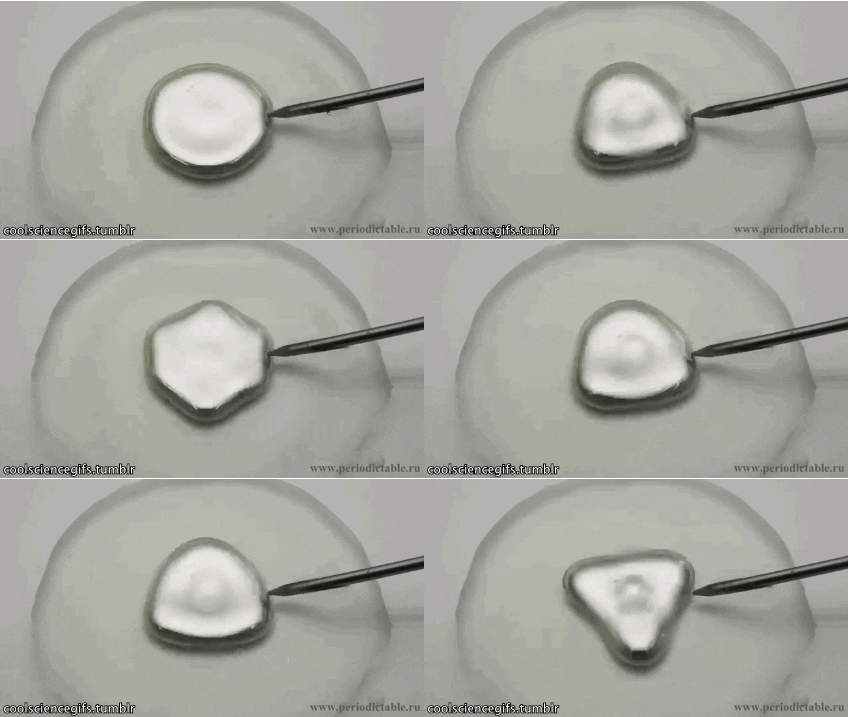
mercury blob oscillator. (The web page includes an explanation and has a video which i can't get to work anymore)
What's happening here is basically that potassium dichromate is rusting the nail. This is a spontaneous process in which energy is released, in fact it releases the energy we put into the iron nail when we refined it from its ore (another form of rust!). That release of energy is what runs the whole fascinating process.
The reaction takes place by putting a mercury blob in a dilute solution of sulfuric acid and placing an iron nail next to it. Then i think in the video, the experimenter drops some potassium dichromate into the solution to get it started. This simple setup of water, mercury blob, nail, sulfuric acid and potassium dichromate is enough to produce complex motion.
Basically the reaction is that the dichromate oxidizes the iron nail. This is similar to the process of rusting, which happens spontaneously in our oxygen filled atmosphere. However, this reaction happens slowly. By placing a mercury blob close to the iron nail, the reaction is sped up, and fun things happen. Mercury is a fluid with a high surface tension and this causes it to form round blobs, like water drops on a waxy surfaces (leaves, feathers..).
First, the dichromate in the solution oxidizes the mercury, forming a layer of mercury sulfate (like a layer of rust on iron). This layer of rust doesn't have as much surface tension as the pure mercury does, so the blob flattens out. As with any oxidation reaction, while the mercury is oxidized, the dichromate Cr2O7(2-) is reduced to the chromium (III) ion. Eventually the blob flattens out enough to touch the nail, now the mercury sulfate layer oxidizes the iron, and again, since the iron is oxidized, the mercury sulfate becomes reduced back to liquid mercury, the blob rounds up again, and the process repeats.
You see in the video that once the experimenter has adjusted the position of the nail just right, the blob then begins to oscillate by itself. It does so in very curious ways! Oscillating in a square shape and then it seems to switch to a triangular shape! Part of this process is mediated by the fact that oxidation/reduction involves a transfer of electrons, and I suppose that the mercury blob will conduct the electrons away from the point of contact with the nail and spread them to the whole surface of rust to reduce it back to mercury. Perhaps different patterns of oscillation would form if the nail were positioned above the center of the blob or even more than one nail were used.
The interesting part of the process is that while the net result of the reaction is that all of the dichromate is eventually reduced to chromium ions and then the process comes to a halt, on the way, the intermediate stage of mercury oxidation and reduction can oscillate.
(This is similar to how the BZ reaction works (another complexity lab) where the bromate oxidizes all the malate to carbon dioxide, but on the way, the intermediate reaction, oxidation/reduction of cerium or iron also oscillates and forms the colored patterns on the petri dish.)

This oxidation and reduction of metals is basically how your battery runs your ipod to make your earbuds oscillate in interesting patterns called music! One metal is oxidizing another metal inside the battery. Eventually the battery runs down. In essence this blob oscillator is the battery and motor combined!
In fact almost everything interesting that happens on earth happens in this manner. For instance we, and all living creatures, can move around and have oscillations (breathing, heart beating..) because these are intermediate reactions within the ultimate process of oxidizing food to carbon dioxide. Even the patterns of weather across the planet is a process of oscillations and cycles that mediate the flow of heat from the sun to outer space as it passes though the earth's atmosphere.
It is true that one day the sun will stop 'burning' and all energy flow will cease. This is what the second law of thermodynamics is all about, that, by itself, the entire universe is running down to a state of high entropy (randomness). The point of these labs, is to show that in the meanwhile, this process of running down drives the spontaneous formation of interesting stable patterns.
mercury blob oscillator. (The web page includes an explanation and has a video which i can't get to work anymore)
What's happening here is basically that potassium dichromate is rusting the nail. This is a spontaneous process in which energy is released, in fact it releases the energy we put into the iron nail when we refined it from its ore (another form of rust!). That release of energy is what runs the whole fascinating process.
The reaction takes place by putting a mercury blob in a dilute solution of sulfuric acid and placing an iron nail next to it. Then i think in the video, the experimenter drops some potassium dichromate into the solution to get it started. This simple setup of water, mercury blob, nail, sulfuric acid and potassium dichromate is enough to produce complex motion.
Basically the reaction is that the dichromate oxidizes the iron nail. This is similar to the process of rusting, which happens spontaneously in our oxygen filled atmosphere. However, this reaction happens slowly. By placing a mercury blob close to the iron nail, the reaction is sped up, and fun things happen. Mercury is a fluid with a high surface tension and this causes it to form round blobs, like water drops on a waxy surfaces (leaves, feathers..).
First, the dichromate in the solution oxidizes the mercury, forming a layer of mercury sulfate (like a layer of rust on iron). This layer of rust doesn't have as much surface tension as the pure mercury does, so the blob flattens out. As with any oxidation reaction, while the mercury is oxidized, the dichromate Cr2O7(2-) is reduced to the chromium (III) ion. Eventually the blob flattens out enough to touch the nail, now the mercury sulfate layer oxidizes the iron, and again, since the iron is oxidized, the mercury sulfate becomes reduced back to liquid mercury, the blob rounds up again, and the process repeats.
You see in the video that once the experimenter has adjusted the position of the nail just right, the blob then begins to oscillate by itself. It does so in very curious ways! Oscillating in a square shape and then it seems to switch to a triangular shape! Part of this process is mediated by the fact that oxidation/reduction involves a transfer of electrons, and I suppose that the mercury blob will conduct the electrons away from the point of contact with the nail and spread them to the whole surface of rust to reduce it back to mercury. Perhaps different patterns of oscillation would form if the nail were positioned above the center of the blob or even more than one nail were used.
The interesting part of the process is that while the net result of the reaction is that all of the dichromate is eventually reduced to chromium ions and then the process comes to a halt, on the way, the intermediate stage of mercury oxidation and reduction can oscillate.
(This is similar to how the BZ reaction works (another complexity lab) where the bromate oxidizes all the malate to carbon dioxide, but on the way, the intermediate reaction, oxidation/reduction of cerium or iron also oscillates and forms the colored patterns on the petri dish.)
This oxidation and reduction of metals is basically how your battery runs your ipod to make your earbuds oscillate in interesting patterns called music! One metal is oxidizing another metal inside the battery. Eventually the battery runs down. In essence this blob oscillator is the battery and motor combined!
In fact almost everything interesting that happens on earth happens in this manner. For instance we, and all living creatures, can move around and have oscillations (breathing, heart beating..) because these are intermediate reactions within the ultimate process of oxidizing food to carbon dioxide. Even the patterns of weather across the planet is a process of oscillations and cycles that mediate the flow of heat from the sun to outer space as it passes though the earth's atmosphere.
It is true that one day the sun will stop 'burning' and all energy flow will cease. This is what the second law of thermodynamics is all about, that, by itself, the entire universe is running down to a state of high entropy (randomness). The point of these labs, is to show that in the meanwhile, this process of running down drives the spontaneous formation of interesting stable patterns.
Sunday, April 18, 2010
Robin poetry
I want to know what the birds are saying!
Robins make up their songs in a series of verses. most of the time i hear them sing about 4 to 6 phrases or tweets per verse. Robins usually know about a dozen or two different kinds of tweets. Often at the end of each verse they will sing a very high pitched 'hissely'. When analyzed with a computer, we find that robins sing about 50 different kinds of hisselys. Odd. I don't remember how they learn their tweets, either from each other or they make them up as they mature. Either way, each robin knows a distinct set of tweets.
What are they saying? How carefully are they composing? According to studies reported by Donald Kroodsma, in his book "the singing life of birds" many birds definitely are composing as they go. Either learning from each other, reacting to each other... The brown thrasher has been recorded to know about a 1000 different tweets, which it sings in very quick succession, improvising many on the spot. A Charlie Parker of birds.
http://www.thesinginglifeofbirds.com/
here's a Robin reciting poetry at Riverside Park in NYC.
The first step in decoding what this robin is saying is to count the number of tweets in each verse:
riverside robin sings
5
6
7
7
6
6
6
6
6
then you chart out his song:
5 _ _ _ _ _
6 _ _ _ _ _ _
7 _ _ _ _ _ _ _
7 _ _ _ _ _ _ _
6 _ _ _ _ _ _
6 _ _ _ _ _ _
6 _ _ _ _ _ _
6 _ _ _ _ _ _
6 _ _ _ _ _ _
then you start listening for tweets you recognize and fill them into the spaces. eventually you transcribe his song. Here is my transcription:
riverside robin:
\ \ ~ ~ '
\ \ ~ ~ w V (end of verse)
\ \ ~ ~ ~ w
\ ~ ~ ~ w V (end of verse
^ v ^ v _ .
^ v ^ w ~ w
^ v ^ v ^ v
^ v ^ v ^ v
^ v ^ v ^ .
Now of course this is as a human hears it. I hear a set poem. I don't know how robins hear it. I would like some day to record lots of robins and hear if they often make structures like this.
I suppose the test is to make up our own robin poems and see how other robins respond to them. Ongoing research!
Robins make up their songs in a series of verses. most of the time i hear them sing about 4 to 6 phrases or tweets per verse. Robins usually know about a dozen or two different kinds of tweets. Often at the end of each verse they will sing a very high pitched 'hissely'. When analyzed with a computer, we find that robins sing about 50 different kinds of hisselys. Odd. I don't remember how they learn their tweets, either from each other or they make them up as they mature. Either way, each robin knows a distinct set of tweets.
What are they saying? How carefully are they composing? According to studies reported by Donald Kroodsma, in his book "the singing life of birds" many birds definitely are composing as they go. Either learning from each other, reacting to each other... The brown thrasher has been recorded to know about a 1000 different tweets, which it sings in very quick succession, improvising many on the spot. A Charlie Parker of birds.
http://www.thesinginglifeo
here's a Robin reciting poetry at Riverside Park in NYC.
The first step in decoding what this robin is saying is to count the number of tweets in each verse:
riverside robin sings
5
6
7
7
6
6
6
6
6
then you chart out his song:
5 _ _ _ _ _
6 _ _ _ _ _ _
7 _ _ _ _ _ _ _
7 _ _ _ _ _ _ _
6 _ _ _ _ _ _
6 _ _ _ _ _ _
6 _ _ _ _ _ _
6 _ _ _ _ _ _
6 _ _ _ _ _ _
then you start listening for tweets you recognize and fill them into the spaces. eventually you transcribe his song. Here is my transcription:
riverside robin:
\ \ ~ ~ '
\ \ ~ ~ w V (end of verse)
\ \ ~ ~ ~ w
\ ~ ~ ~ w V (end of verse
^ v ^ v _ .
^ v ^ w ~ w
^ v ^ v ^ v
^ v ^ v ^ v
^ v ^ v ^ .
Now of course this is as a human hears it. I hear a set poem. I don't know how robins hear it. I would like some day to record lots of robins and hear if they often make structures like this.
I suppose the test is to make up our own robin poems and see how other robins respond to them. Ongoing research!
Subscribe to:
Posts (Atom)
