pg 31:
"The God of the old testament is arguably the most unpleasant character in all fiction: jealous and proud of it; a petty, unjust, unforgiving control-freak; a vidictive, bloodthirsty, ethnic cleanser; a misogynistic, homophobic, racist, infanticidal, genocidal, filicidal, pestiliential, mealomaniacal, sadomasochistic, capriciously malevolent bully."
It would be interesting to respond to this. The character of yhvh in tanakh from b'reishit to malakhim is curious. The experience that the human characters have is another thing. And then there is the experience that the writers are trying to portray. In fact, the question is: JUST WHAT is each writer trying to do? So for instance some people angry at religion want to assume that the writers are lying for the purpose of scaring stupid people into listening to priests.
"it is unfair to atttack such an easy target. The God Hypothesis should not stand or fall with its most unlovely instantiation.. nor the opposite face gentle jesus."
>God hypothesis:
>there exists
>a superhuman intelligence
>supernatural intelligence
i don't understand the meaning of supernatural. i wonder if he's gonna do some anthropology in this book.
>who deliberately designed
>and created
>the universe and everything in it,
>including us
That's too much and too little i'm afraid!
pg 32 he has a hard time sticking to a topic.
"it is not clear why the change from polytheism to monotheism should be assumed to be a self-evidently progressive improvement. But it widely is..." till you get rid of just one MORE god, and presto atheism..
will he explore this?
he gets lost. it looks as if he is going to DESCRIBE polytheism, instead he gets lost on a tangent about tax exempt status of religions.. very poor.
pg 35 this is just glib sophomoric "nya nya na nya nya" he is poking at people he thinks are dumb. He's doing no carefull ethological work on the religious behavior of Homo sapiens. he's just cocking his feathers fancifully so the girls will like him.
pg 36 he makes sure to call FEMINIST theologians "ditzy" nice.
oh so now he comes out and says
"I am aware that critics of religion can be attacked (!?! see, he's in FIGHT mode, a boy!) for failing to credit the fertile diversity of traditions and world-views that have been called reigious. Anthropologically informed works , from Sir James Frazer's "Golden Bough" (?!?) to Pascal Boyer's "religion explained or scott atran's "in gods we trust" fascinatingly document... read such books and marvel at the richness of human gullibility (more off handed remarks)"
"but that is not the way of this book. I decry supernaturalism in all its forms, and the most effective way to proceed will be to concentrate on the form most likely to be familiar to my readers - the form that impinges most threatening on all our societies. "
the 3 great monotheism which trace themselcves back to the mythologial abraham.
"this is a good moment to forestall an inevitable retort..the god dawkins doesn't believe in is a god i don't believe in either.. i don't believe in an old man in the sky with a long white beard... that's an irrevelent distraction.. from the fact that what the speaker really believes in is not a whole lot less silly"
"I'm not attacking any particular version of God or gods. I am attacking any particular version of God or gods. I am attacking God [listen to dawkins puff up his opponent so that he looks like a mighty davy to his goliath!], all gods, anything and everything supernatural wherever and whenever they have been or will be invented."
well that's a lofty goal. it's also terribly general. and that doesn't sound like the approach of a biologist. Dawkins is NO biologist!
pg 37 quote at top of page, there he goes again with that "barbaric bronze age text" bullshit. gore vidal this time. what bronze age text? no evidence that it comes from bronze age...
D says that judaism is older and CLEARLY the ancestor of christianity and islam.
the judaism we know today, rabinic judaism seems to have grown side by side with christianity. do we REALLY have any knowlege of it BEFORE christianity developed on the scene? judaism "originally a tribal cult" does that have a specific meaning or does D just mean to paint a picture of a bunch of head hunters dressed in feathers? "originally a tribal cult of a single fiercely unpleasant God, morbidly obsessed with sexual restrictions, smell of charred flesh, his own superiority over rival gods and with the exclusiveness of his chosen desert tribe"
huh? he's describing judaism by refering to a god, whom he is trying to show is imaginary? he's taking a text which he believs to be fairy tales as an anthroplogical account of a moment in history of human peoples?
these 'theists' are stupid!
then he points out christianity and islam are spread by the sword.
then we see that this is NOT the work of a scholar, but a pop book by a celebrity:
"for most of my purpose all three Abrahamic religions can be treated as indistinguishable. unless otherwise stated i shall have christianity mostly in mind, but only because it is the version with which i happen to be most familiar [so he doesn't have the guts to do the hard work and LEARN about the others? some animal ethologist. he's LAZY!] for my purposes the differences matter less than the similarites. and i shall not be concerned at all with other religions such as Buddhism or Confcianism [that's a religion?] Indeed there is something to be said for treating these not as religions at all but as ethical systems or philosophies of life."
huh! interesting game he is playing. every thing he DOESN'T like, he'll call a religion, and everything he likes will be called an ethical system or philosophy. i suppose he wants to focus on the idea of an intelligent being who created the universe for the purpose of playing out a drama with ONE species, Homo sapiens, for whom he has a particular plan. hmm..
so first of all some census data. what percentage of people who use the word "god" use it in that sense. and why do people use the word "god" to mean other things?
p38
"The simple definition of the God Hypothesis with which i began has to be substantially fleshed out if it is to accomodate the abrahamic god. he not only created the niverse; he is a personal god dwelling within it, or perhaps outside it (whatever that might mean) [well? which is it? is there a unified enough conception of this god for you to write about or NOT?] possesing the unpleasant human qualities to which i have alluded"
then he makes a passing mention of thomas paine's 'deist god' saying at on one hand he is very different, almost the laws of physics, but a supreme intelligence nevertheless.
is he going to really explore in detail the demographic that thinks about god in the way he is sloppily fleshing out? and is he interested in the breadth of huuman conceptions associated with god and religion or not? is he going for UNDERSTANDING or RIDICULE?
p39 and now he gets distracted again by discussing the founding of the united states as a secular state... i don't get this guy.
and now pg 40 he does ask an anthropological question (for a moment he forgets he's nder attack? if the u.s. was founded secular and england was a religious state why are the tables now turned?
1) u.s. has immigrants who hold onto religius identitties for cohesion
2) england was wearied by all the religious wars
3) becase u.s. was secular rival religions were free to compete for congregants and the market went wild.
4) the english system with its country vicars evolved into a kind of benign deism. (but WHY?)
and now he wants to know if any of the founding fathers were out and out atheists.
he's so confused. i thought this was his chapter on the 'god hypothesis'???
pg 44 comparing to public attitude to atheists: " yet the jewish lobby is notoriously one of teh most formidably influential in Washington."
huh? up there with oil and pharmaceuticals? no data of course.
why is this brit, writing mostly about AMERICAN social phenomena?
this is so sloppy is this a chap on God hypothesis or a rambling about current events of violence in america against atheists? i'm confused.
oh that was all supposed to be a subchapter on the 'deist hypothesis' this writing sucks.
pg47. now he will talk about agnosticism. wait.. he hasn't even defined the god hypothesis for me or at least described how people use it.. in detail.
he begins by calling agnostics "namby pamby, mushy pap, weak tea, weedy palllid fence sitters". Oh that's scholarly! That's discussion!
pg 47 so he says it's alright to be agnostic on teh topic of what caused the permian extinction. Well, yes, i can ask for a detailed description of the permian exitnction. masses of paleontolical data, strata fossils. how se define extinction rates, morphospecies etc...
but, Dawkins, you haven't defined the God hypothesis in enough detail yet for me to decide whether i agree, refute or remain agnostic.
hell you quote sagan as saying it's reasonable to be agnostic on the question of whether there is life elsewhere in the universe. do you mean life with dna, rna, rna polymerase, ribosomes, tRNA, tRNAases, ATPase and the host of bioenergetic redox catalysts that run the whole thing inside lipid membranes? or do you mean something more general?
he says two kinds of agnosticism: TAP something caused the permian extinction and we WILL or CAN eventually find the evidence.
PAP what color do you see when i see red, there is NO way to find evidence. so i used that argument with tom, but now i am not so sure. we ARE beginning to taese apart the nrural processes.. but will we ever be able to relate them to experiencing? Will i EVER be able to decide whether a very complex computer program which passes teh turing test for me, EXPERIENCES also, something like me? i say i cannot be sure that another human even experiences being alive in the way i do. but then again, there are times when i'm NOT experiencing being alive, so i may be able to track down neural correlates to the times when i'm experiencing and the times i'm not?
so i don't know what to say about this topic yet!
so now pg 50 he says the god hypothesis (which he really hasn't sketched out yet) is a scientific hyptothesis to which we may not have enough evidence or may NEVER have anough evidence but what we CAN do is at least say that the probablity if its truth is way less than 10% or 2% or 0.0002%. hm.. the more precisly you want to do that the more precisely you want to define your hypothesis. and then justify narrowing such a broad range of human behavior into such a narrow hypothesis, or prove to me that a substantial and important portion of humanity follows it.
he presents a spectrum:
1) god 100% jung knows there is a god
2) god 99% well i aint certain but i strongly believe and live accordingly
3)god >50% very uncertain, inclined to belive
4)god nogod 50% can't tell either way
[how on earth does one measure the diff between 4 and 3? a tad silly, no?]
5)god<50 br="" disbelieve="" inclined="" to="" uncertain="" very="">6)99% no god can't know for certain but it's really improbable, i live as if not
7)100% no god. can't imagine many can justify this stance
dawkins says he's 6 leaning on 7.
position 4 (which i don't understand how one can measure) is not the same as PAP, no way to decide. If PAP then no way to even assign probabilites.
russels orbiting teapot: it would be close to impossible to prove it aint out there. (huh? we can look at the records, no teapots were launched into space) (furthermore you produced this teapot example precisely as a kind of intellectual clever arguement. that's NOT the way the god hypothesis came about.)
one camp says one should be agnostic about teapots. one camp atheist.
oh russel is saying some religious think that it is the job of the atheist skeptic to provide eveidence against religion, not the job of the religious to provide evidence for. so he supposes that saying there is a teapot is the same as saying there is god, and it's silly for skeptics to have to bring forth an exhaustive search out there for the little thing. surely it is the burden of the proposer of the teapot to bring evidence. One problem with this paralel is that russel just cooked up the teapot idea for the sake of argument. The god idea has been evident in human cultures around the world for 1000s of years with 100s of millions of adherents.
if russel says there is a teapot out there, i will just ignore him as being a looney or being too clever. if 100s of millions of humans over earth for 1000s of years say there is a god, i'm gonna look into it. at least to find out what they mean and why. i wouldn't care less whether russel meant his teapot to be ceramic or iron.
oh, pg 53, his point is here is an example of a hypothesis while we can't find exclusive eveidence, the probablitity of there being a teapot is NOWHWERE = to the probability of there NOT being a teapot. So we don't bother to look. so just because you can't PROVE "god doesn't exist" doesn't mean that we can't say "he VERY probably does not exist"
ok. why not stronger contention: "why are you even INTERSTED in such arcane stuff. There's children and history and meadows and experiments and civics..."
well, this is all well and good. i know how to think about whether and how a teapot can or cant get into orbit around the sun. but i still don't know how to think about what people MEAN by god. and i suspect that dawkins won't help me.
"...when asked whether i'm an atheist to point out that the questioner is also an atheist when considering zeus... wotan... flying spaghetti monster.."
hmm... is this solid? i think not. Can dawkins assert that any given christian does not believe in zeus? do either of them even KNOW WHAT IT MEANS to believe in zeus or not? what's the hypothesis? that he throws thunderbolts while sitting on clouds? ok, bar then what about allah? people believe in allah, now. ditto. how do i know that that christian professing his christianity doesn't have roughly the same conception as another particular moslem has about allah? Just that they speak different languages? i suppose it all boils down to how literal. What's the definitions? Moslems say jesus is NOT god. Christians say jesus IS god. The HISTORICAL? jesus? That god became human for a time? Do all who call themselves christian beleive this? Gabe? ****
and what about the retort, "come on Bar, you know damm well what most people mean by god" umm no, i spent a few years in college researching that, asking that, exploring that, i don't know what they mean. I don't even know what red looks like to them. Do you know what durga means? hmm... she's insecure, she heryo worships. she's in love with her bishop in a way i would never be. she was in love with me in a way i wasn't in love with her. she WANTS someone to guide her. she doesn't think she can go out on her own and define the way to go. she has spent her life in administrative support roles. so had Tanya. and with tanya, could i even say: "I know your conception of religion is wrong"? NO, there was a point in her thinking process beyond which i could not break into. she kept very hidden. therefore there is no way i could say her conception was wrong, becuase there was no way i could even FIND her conception.
couldn't you guess? yeah. i could guess that she wanted parents that loved her and her total religious behavior was in response to that. it's not a matter of logically defined entities. hence this atheist-theist arguement is only so much ruffling of feathers. silly.
but important point. do you suppose there are masses of people who CAN'T sustain a skeptical life dealing with reality every day but who can only master a lower grade of existence of touching relity a little, following along and spending most of their time in a constructed world?
whether they believe in god isn't the issue, the issue is: are they constitutionally capable of leading self directed lives? Is democracy REALLY possible?
suppose people like dawkins had their way and 100s of millions of believers went into therapy and got cured of their belief. First of all... are they even capable of letting go? and if so, are they strong enough to live without it? It's been the way for the masses for 1000s of years, maybe 10s of thousands. Does Dawkins and his ilk have ANY grounds to believe that the majority of humanity can master life to the level that his fellow academics can?
i have my doubts.
Tuesday, May 19, 2015

Saturday, January 31, 2015
34 Different Phyla besides Plants and Animals to Consider For Enigmatic Fossils
(this is a sketch, i hope to flesh this article in)
34 multicellular or syncitium or large euk/prok phylla
Cyanobacteria
Oscillitoria grow sheets with morphology, marine groups form stromatolites, Nostoc etc... form gell colonies, various symbiotic forms with fungi, plants...
ANY OTHER BACTERIA THAT FORM DISTINCT COLONIES? I RECALL ONE OTHER
Rhodobionta 5,500
red algae in ocean there any freshwater?
Porphyria, Chondrus crispus, Polysiphonia, Ceramium, Corallina, Gigartina, Lithothamnion
Ulvophyta 3,679
green algae ocean and fresh
volvox, all the tiny colonies, cladophora on fishtanks, Ulva, Monostroma, Enteromorpha intestinalis, E. linza, Chaetomorpha linum, Codium fragile, feathery ones no big freshwater ulvos?
Klebsormidiophyta 40 ?
filiments, klebsormidium, stichococs, rhaphidonema, freshwater
Chaetosphaeridiophyta 4 ?
single celled connected by mucilage
Charophyta 81 Nitella, Chara
many chloroplasts, single vacuole, spiral cells arround oogonia, mostly freshwater
Coleochaetophyta 13 ?
setae multicelled resh water
Embryophyta 269,200
Psilotum, Sphagnum, Polytrichales, acrocarps, pleurocarps, liverworts, hornworts, clubmosses, selaginacee, ferns, horsetails, gnetophytes, cycads, gingko, angiosperms
Zygnematophyta 4000 conjugatophyta
spyrogyra, aren't there macro patches of desmids? not a colony though
Ciliata 8000
can see stentor, vorticella colonies are visible,
Dynophyta 2,200 marine
some colonies up to 8 long marine, most comon phtosynthetic symbiotes in corals, endosymbiotize many photosynthesizers, also endosymbioted by forams...
Bacillariophyta 106,000
marine and fresh colonial, u can see fresh water colonies as brown rusty fuzz
Phaeophyta 900 spp? marine
Ascophylum, Fucus, Leathesia, Laminaria, Agarum, strings, sargassum
Chrysophyceae ???
freshwater, no meiotic sex, some phagocytosis
diverse multicellularity, long and short undulis
Xanthophyceae 100
mostly fresh, some terrestrial
single, multicell, sycytiums. vaucharia films on soil
Oomycota 500-800
freshwater and terrestrial parasites of fish and plants and also heterotrophs on rotting veg?
phytophthora, saprolegnia, achlya, plasmopara, peronospora, pythium
Plasmodiophorida 29? plasmodiophora
symbiotes in plants, feeding stage is cyncytium, zoospores with two unequal undulipodia, uninucleate cysts
Hyphochytriomycetes
Rhizidiomyces (parisitizes saprolegnia on fish)
single mastigonemate unduli, no sex, freshwater, soil
parasitize fungi, plants, insect carcasses
zoospores land on a victim, encyst and enter the host, grow into a cyncytium, eventually the cyncitium exits the host and cleaves into many small zoospores which disperse
Labyrinthulomycetes 15
ectos on sea grass
labyrinthula, thraustochytrium
cells enclosed in outer membrane slime net, cytoplasms connected, slime net has cytoplasm? and microtubules!
no plastids, not amoeboid, sex, external digestion sends out enzymes
Foraminifera 6000
mostly marine, some marine cells cms large
NO COLONIAL? endosymbiotize lots of critters
Chlorachniophyta 6 ???
nucleomorph from ulvophytes
naked cells, joined by filopods into a plasmodium
capture and phagocytize prey
flagellated zoospores, single flagellum,
radiolarian colonies can be gigantic i don't know which group, confused, also they have varied endosymbiotes
the colonies are only marine?
Kinetoplastida
(trypanosoma)
Cephalothamnion cyclopum forms colonies of a dozen or so cells attached to a stalk.
Acrasiomycetes
Acrasia, Guttulina, guttulinopsis
terrestrial, stalk cells don't make cellulose, stay alive! can germinate.
Pocheina come out of spores and have 2 undulis. live on conifer bark and lichenized dead wood
Dictyosteliomycetes
Acytostelium, Dictyostelium, Polysphondylium, Coenonia
Terrestrial, stalk cells die and leave cellulose walls
cAMP signals, haploid amoeba
Myxomycetes 500
Fuligo, Lycogala, Physarum, Protostelia (?) Stemonitis
large terrestrial, freshwater syncytiums
Chytridiomycota 1000
Physoderma, chytria, Basidiobolus ranarum, Blastocladiella
tiny single celled syncitiums? how large?
1+ flagella, chitin , glucans
haplodiploid altern gens, quasi amoeboid phase
fresh water or soil
Zygomycota
Mucor, Rhizopus, Phycomyces, Pilobolus, Entomophthora, Dactylaria catches nematodes
no cross walls, haploid, zygospores
ANY AQUATIC?
Ascomycota 60,000
terrestrial, some marine symbiotes of algae
FRESHWATER?
ascus haploid, many have appeared to have abandoned sex (deuteros) parasexual cycle, crosswalls,
Lichens 13,500
some aquatic, marine!
Verrucaria serpuloides is submerged marine
Dermatocarpon fluviatile and hydrothyria venosa grow in streams
Basidiomycota 30,000
haploid dikaron, basidium, doliopore septum
some yeasts
DON'T KNOW IF ANY AQUATIC
Glomerulomycota
obligate symbionts of plant roots. arbuscular mycorrhyza, Geosiphon Pyriforme mm high symbiotes with Nostoc punctiforme some may mychorrhyze roots, Nostoc from liverwort Blasia and Plant Gunnera can also form these? odd!
Choanoflagellata 120
Codosigidae: colonial naked cells
aquatic FRESH? MARINE?
Metazoa 1,200,000
land phyla: flatworms, chordates, arthropods, tardigrads, onychophorans, mollusks, annelids, nematodes, horsehair worms(parasitic), rotifers 10/35
Xenophyophora ??
Tendal, O. S. 72 "a monograph of xenophyophora" Galathea reports (???) 12:7-103
what are they? hard to collect intact, dna analysis? related to forams. large. syncytiums?
Bicosoecids
marine shell and forward mastigonemate undulli, other is smooth along cell. in cross section the kinetid has row of 10 mt, and row of 3.
tend to form colonies. no sex. similar to some chrysos
no cytostomes, lorica, tubulomitochondria. stalked, looks like a chaonoflagelate without collar.
34 multicellular or syncitium or large euk/prok phylla
Cyanobacteria
Oscillitoria grow sheets with morphology, marine groups form stromatolites, Nostoc etc... form gell colonies, various symbiotic forms with fungi, plants...
ANY OTHER BACTERIA THAT FORM DISTINCT COLONIES? I RECALL ONE OTHER
Rhodobionta 5,500
red algae in ocean there any freshwater?
Porphyria, Chondrus crispus, Polysiphonia, Ceramium, Corallina, Gigartina, Lithothamnion
Ulvophyta 3,679
green algae ocean and fresh
volvox, all the tiny colonies, cladophora on fishtanks, Ulva, Monostroma, Enteromorpha intestinalis, E. linza, Chaetomorpha linum, Codium fragile, feathery ones no big freshwater ulvos?
Klebsormidiophyta 40 ?
filiments, klebsormidium, stichococs, rhaphidonema, freshwater
Chaetosphaeridiophyta 4 ?
single celled connected by mucilage
Charophyta 81 Nitella, Chara
many chloroplasts, single vacuole, spiral cells arround oogonia, mostly freshwater
Coleochaetophyta 13 ?
setae multicelled resh water
Embryophyta 269,200
Psilotum, Sphagnum, Polytrichales, acrocarps, pleurocarps, liverworts, hornworts, clubmosses, selaginacee, ferns, horsetails, gnetophytes, cycads, gingko, angiosperms
Zygnematophyta 4000 conjugatophyta
spyrogyra, aren't there macro patches of desmids? not a colony though
Ciliata 8000
can see stentor, vorticella colonies are visible,
Dynophyta 2,200 marine
some colonies up to 8 long marine, most comon phtosynthetic symbiotes in corals, endosymbiotize many photosynthesizers, also endosymbioted by forams...
Bacillariophyta 106,000
marine and fresh colonial, u can see fresh water colonies as brown rusty fuzz
Phaeophyta 900 spp? marine
Ascophylum, Fucus, Leathesia, Laminaria, Agarum, strings, sargassum
Chrysophyceae ???
freshwater, no meiotic sex, some phagocytosis
diverse multicellularity, long and short undulis
Xanthophyceae 100
mostly fresh, some terrestrial
single, multicell, sycytiums. vaucharia films on soil
Oomycota 500-800
freshwater and terrestrial parasites of fish and plants and also heterotrophs on rotting veg?
phytophthora, saprolegnia, achlya, plasmopara, peronospora, pythium
Plasmodiophorida 29? plasmodiophora
symbiotes in plants, feeding stage is cyncytium, zoospores with two unequal undulipodia, uninucleate cysts
Hyphochytriomycetes
Rhizidiomyces (parisitizes saprolegnia on fish)
single mastigonemate unduli, no sex, freshwater, soil
parasitize fungi, plants, insect carcasses
zoospores land on a victim, encyst and enter the host, grow into a cyncytium, eventually the cyncitium exits the host and cleaves into many small zoospores which disperse
Labyrinthulomycetes 15
ectos on sea grass
labyrinthula, thraustochytrium
cells enclosed in outer membrane slime net, cytoplasms connected, slime net has cytoplasm? and microtubules!
no plastids, not amoeboid, sex, external digestion sends out enzymes
Foraminifera 6000
mostly marine, some marine cells cms large
NO COLONIAL? endosymbiotize lots of critters
Chlorachniophyta 6 ???
nucleomorph from ulvophytes
naked cells, joined by filopods into a plasmodium
capture and phagocytize prey
flagellated zoospores, single flagellum,
radiolarian colonies can be gigantic i don't know which group, confused, also they have varied endosymbiotes
the colonies are only marine?
Kinetoplastida
(trypanosoma)
Cephalothamnion cyclopum forms colonies of a dozen or so cells attached to a stalk.
Acrasiomycetes
Acrasia, Guttulina, guttulinopsis
terrestrial, stalk cells don't make cellulose, stay alive! can germinate.
Pocheina come out of spores and have 2 undulis. live on conifer bark and lichenized dead wood
Dictyosteliomycetes
Acytostelium, Dictyostelium, Polysphondylium, Coenonia
Terrestrial, stalk cells die and leave cellulose walls
cAMP signals, haploid amoeba
Myxomycetes 500
Fuligo, Lycogala, Physarum, Protostelia (?) Stemonitis
large terrestrial, freshwater syncytiums
Chytridiomycota 1000
Physoderma, chytria, Basidiobolus ranarum, Blastocladiella
tiny single celled syncitiums? how large?
1+ flagella, chitin , glucans
haplodiploid altern gens, quasi amoeboid phase
fresh water or soil
Zygomycota
Mucor, Rhizopus, Phycomyces, Pilobolus, Entomophthora, Dactylaria catches nematodes
no cross walls, haploid, zygospores
ANY AQUATIC?
Ascomycota 60,000
terrestrial, some marine symbiotes of algae
FRESHWATER?
ascus haploid, many have appeared to have abandoned sex (deuteros) parasexual cycle, crosswalls,
Lichens 13,500
some aquatic, marine!
Verrucaria serpuloides is submerged marine
Dermatocarpon fluviatile and hydrothyria venosa grow in streams
Basidiomycota 30,000
haploid dikaron, basidium, doliopore septum
some yeasts
DON'T KNOW IF ANY AQUATIC
Glomerulomycota
obligate symbionts of plant roots. arbuscular mycorrhyza, Geosiphon Pyriforme mm high symbiotes with Nostoc punctiforme some may mychorrhyze roots, Nostoc from liverwort Blasia and Plant Gunnera can also form these? odd!
Choanoflagellata 120
Codosigidae: colonial naked cells
aquatic FRESH? MARINE?
Metazoa 1,200,000
land phyla: flatworms, chordates, arthropods, tardigrads, onychophorans, mollusks, annelids, nematodes, horsehair worms(parasitic), rotifers 10/35
Xenophyophora ??
Tendal, O. S. 72 "a monograph of xenophyophora" Galathea reports (???) 12:7-103
what are they? hard to collect intact, dna analysis? related to forams. large. syncytiums?
Bicosoecids
marine shell and forward mastigonemate undulli, other is smooth along cell. in cross section the kinetid has row of 10 mt, and row of 3.
tend to form colonies. no sex. similar to some chrysos
no cytostomes, lorica, tubulomitochondria. stalked, looks like a chaonoflagelate without collar.
Thursday, July 10, 2014
I've Learned To Make Movies Of My Cellular Automata!
We met langton's ant some time ago, here is a movie I made of it. Takes 7minutes. Not sure how to speed up the movie yet.
here is my code:
#this is a generator function for yielding an NxN cellspace for langton's ant
#for gens number of generations
#grp2 and display are my own imaging library, it's a bit dopey, it doesn't take part in the
#creation of the movie file
def langton(gens,N,px, delay, fill=lambda x,y : None ):
"""langton(gens,N,px,delay,fill) --
do langton's ant in an NxN field
withh pix size px and delay between steps
fill is an optional function of cellspace and
N which can fill cellspace with an initial
pattern"""
canv=grph2.Grph(N,N,px,'langton')
#make a label box for gen
canv.gens=grph2.k.Label(canv.win)
canv.gens.pack()
dirs=((0,-1), (1,0), (0,1), (-1,0))
gen,antx,anty,ant_dir=0,N//2, N//2, 0
cellspace=[[0]*N for i in range(N)]
fill(cellspace,N)
display(cellspace, canv, N)
canv.upd()
for ii in xrange(gens):
if cellspace[antx][anty]:
cellspace[antx][anty]=0
canv.unplot(antx,anty)
ant_dir=(ant_dir-1)%4
else:
cellspace[antx][anty]=1
canv.plot(antx,anty)
ant_dir=(ant_dir+1)%4
antx+=dirs[ant_dir][0]
anty+=dirs[ant_dir][1]
#put gen in label
canv.gens.config(text=str(gen))
canv.upd()
gen+=1
for i in xrange(delay): pass
yield cellspace
#this creates a python imaging library image from a list of coordinates that
#should be painted as black squares of pxXpx number of pixels each
import Image
def ctimgf(coords,px,N,M,bkgr=(255,255,255),
pts=(0,0,0)):
"""ctigf(coords, fname, px, N, M, bkgr=(255,255,255),
pts=(0,0,0) --
return an (N*px) X (M*px) image file for the coords"""
im=Image.new('RGB',(N*px,M*px),bkgr)
pix=im.load()
for x,y in coords:
for i in xrange(px):
for j in xrange(px):
pix[x*px+i,y*px+j]=pts
return im
this calls my langtons ant program for gens number of generations and produces an image file for each generation
def langfmov(gens,sz,px,delay):
"""langfmov(gens,sz,px,delay,dur) -- display langton ant
for gens gens and write a file for each gen in format
lang00001.jpg etc.. """
#create indesx i and cellspace cs for each generation of langton's ant
for i, cs in enumerate(langton(gens,sz,px,delay)):
#create a list of coordiates for each 'on' cell in the ant's pattern
lp=[(x,y) for x,yl in enumerate(cs) #x is the row coordinate and yl is the row
for y,val in enumerate(yl) if val==1] #y is the collumn coordinate
#save an image file of those on and off coordinates
ctimgf(lp,px,sz+1,sz+1).save("lang%05d.jpg" % i)
#my god that code is terse! i let python get me carried away! and i got x,y revered i think
#i call it:
langfmov(11000, 65, 4, 0)
#only took my computer a minute to produce 11,000 5kb jpgs
#the final command to make the movie i give in linux:
avconv -f image2 -i lang%05d.jpg lang10000.avi
#('m not sure what the -f image2 command does!)
#only takes about 19seconds to create a 10mb movie!!!
here is my code:
#this is a generator function for yielding an NxN cellspace for langton's ant
#for gens number of generations
#grp2 and display are my own imaging library, it's a bit dopey, it doesn't take part in the
#creation of the movie file
def langton(gens,N,px, delay, fill=lambda x,y : None ):
"""langton(gens,N,px,delay,fill) --
do langton's ant in an NxN field
withh pix size px and delay between steps
fill is an optional function of cellspace and
N which can fill cellspace with an initial
pattern"""
canv=grph2.Grph(N,N,px,'langton')
#make a label box for gen
canv.gens=grph2.k.Label(canv.win)
canv.gens.pack()
dirs=((0,-1), (1,0), (0,1), (-1,0))
gen,antx,anty,ant_dir=0,N//2, N//2, 0
cellspace=[[0]*N for i in range(N)]
fill(cellspace,N)
display(cellspace, canv, N)
canv.upd()
for ii in xrange(gens):
if cellspace[antx][anty]:
cellspace[antx][anty]=0
canv.unplot(antx,anty)
ant_dir=(ant_dir-1)%4
else:
cellspace[antx][anty]=1
canv.plot(antx,anty)
ant_dir=(ant_dir+1)%4
antx+=dirs[ant_dir][0]
anty+=dirs[ant_dir][1]
#put gen in label
canv.gens.config(text=str(gen))
canv.upd()
gen+=1
for i in xrange(delay): pass
yield cellspace
#this creates a python imaging library image from a list of coordinates that
#should be painted as black squares of pxXpx number of pixels each
import Image
def ctimgf(coords,px,N,M,bkgr=(255,255,255),
pts=(0,0,0)):
"""ctigf(coords, fname, px, N, M, bkgr=(255,255,255),
pts=(0,0,0) --
return an (N*px) X (M*px) image file for the coords"""
im=Image.new('RGB',(N*px,M*px),bkgr)
pix=im.load()
for x,y in coords:
for i in xrange(px):
for j in xrange(px):
pix[x*px+i,y*px+j]=pts
return im
this calls my langtons ant program for gens number of generations and produces an image file for each generation
def langfmov(gens,sz,px,delay):
"""langfmov(gens,sz,px,delay,dur) -- display langton ant
for gens gens and write a file for each gen in format
lang00001.jpg etc.. """
#create indesx i and cellspace cs for each generation of langton's ant
for i, cs in enumerate(langton(gens,sz,px,delay)):
#create a list of coordiates for each 'on' cell in the ant's pattern
lp=[(x,y) for x,yl in enumerate(cs) #x is the row coordinate and yl is the row
for y,val in enumerate(yl) if val==1] #y is the collumn coordinate
#save an image file of those on and off coordinates
ctimgf(lp,px,sz+1,sz+1).save("lang%05d.jpg" % i)
#my god that code is terse! i let python get me carried away! and i got x,y revered i think
#i call it:
langfmov(11000, 65, 4, 0)
#only took my computer a minute to produce 11,000 5kb jpgs
#the final command to make the movie i give in linux:
avconv -f image2 -i lang%05d.jpg lang10000.avi
#('m not sure what the -f image2 command does!)
#only takes about 19seconds to create a 10mb movie!!!
Thursday, July 3, 2014
More Pretty Math Patterns: Spiral Fibonaci Strings
You may have heard of the Fibonacci numbers:
f0=0, f1=1 and fn=f(n-1) + f(n-2), so that the numbers are:
0,1,1,2,3,5,8.... (you add the last two numbers to get the next. the next one will be 13)
There are tons of fun facts about these critters.
Today I saw something similar - Fibonacci strings:
f0='0', f1='1' and fn = f(n-1) concatenated with f(n-2), so the strings are:
'0', '1', '10', '101', '10110', '10110101', ,...
(you tack the second to last string at the end of the last string to get the next. the next one is '1011010110110'. This can be extended as long as we like.
When i saw this I immediately decided I wanted to plot it in a spiral, don't ask me why...
 So the spiral would start from a '1' at the center, then a '0' to the right and then up and counterclockwise:
011
110
01...
here is a plot for the Fibonacci string large enough to fill an 11x11 plot (I filled in the ones and zeros in the center where it starts)
 That's weird... doesn't seem to be any pattern. I didn't really expect one either! lets try a bigger plot with more of the string:
Well, that's curious, more:
 Seems to be two kinds of regions..
 Now we see some kind of pattern
 It's a metaspiral on the spiral, very weird. Does it continue?

Apparently it does. I have no clue why this happens, it will bear some careful observation and thinking! The length of the Fibonacci string grows exponentially, the length of one trip around the spiral grows...
1
8=1+1+1+1+4
3+3+3+3+4=16
5+5+5+5+4=24
so it grows by 8 each time. That's linear. I don't see why they match up in such a curious fashion!
UPDATE:
i drew some lines and did some counting:

here is a smaller region:

Look at the metaspirals bands on the right. focus on the ones made up of mostly horizontal rows of dots. I will find out how far apart they are. notice in some places the horizontal row of dots is only two long. i will count how many spiral lines between these.
there are 18. this is consistent in the bigger pic too.
now each spiral grows by 8 squares as it comes around. so the first spiral of any metaspiral band is 8*18 squares longer than the first spiral of the previous band. 8*18=144 which is the 12th fibonacci number.
THIS is a CLUE. though i'm still clueless about what is going on!
For those of you curious about my computer code, here it is in python:
#first create the Fibonacci string:
fs=['0','1']
while len(fs[-1]) < 1000000:
fs.append(fs[-1]+fs[-2])
fs=fs[-1] #choose the last string produced
#now create an image of the spiral with this string:
def make_fib_sp(N, px, fname, fibstr):
"""make_fib_sp(N, px, fname, fibstr) -- create an image file fname
(give it an extension like .jpg or .png...)
of a pattern of pixels based on starting from the
center of the image and working one pixel around in a
spiral based on the mapping with the fibonacci string fibstr:
f0='0',f1='1', fn+1=fn concat fn-1
look at a fibonacci string long enough to fill an NxN square
and around the spiral draw black if 1 and white if 0
uses Image library and spriral
px is the number of pixels in the image to make each square"""
from PIL import Image #python image library
bkgr=(255,255,255); pts=(0,0,0) #background is white, pts are black
img=Image.new('RGB',(N*px,N*px),bkgr) #create an Image object
pix=img.load() # this is for fast construction of image
idx=0
ctr=N//2
#I iterate over the coordinates given by my spiral generator
for x,y in mf.spiral(ctr, ctr, lambda x,y,xs,ys:
abs(x-xs)>=ctr-1):
#because spiral stops sloppily...
if x<0 or="" x="">=N or y<0 or="" y="">=N:
break
if fibstr[idx]=='1': #draw a black pixel
xp=x*px; yp=y*px
for i in xrange(px): #fill the square in as px X px pixels
for j in xrange(px):
pix[xp+i,yp+j]=pts
idx+=1
img.save(fname)
def spiral(x,y,exit_fun):
"""spiral(x,y, exit_fun) -
lazily return coordinates in a spiral path starting
from (x,y) then to (x+1,y), (x+1,y-1) etc...
counterclockwise until exit_fun(x,y,xs,ys) is true
xs,ys are the initial center coords
NOTE tests exit function only ONCE around the
spiral so exit_fun should use < or > rather than ==
as an exact value in each round might be missed.
since the spiral goes around with smaller and bigger
values, it's best to use some version of
abs(x-xs) for exit_fun getting it to stop where you
want is subtle"""
incs=2
xs,ys=x,y
if not exit_fun(x,y,xs,ys):
yield x,y
while not exit_fun(x,y,xs,ys):
x+=1; yield x,y
for i in range(incs-1):
y-=1; yield x,y
for i in range(incs):
x-=1; yield x,y
for i in range(incs):
y+=1; yield x,y
for i in range(incs):
x+=1; yield x,y
incs+=2
f0=0, f1=1 and fn=f(n-1) + f(n-2), so that the numbers are:
0,1,1,2,3,5,8.... (you add the last two numbers to get the next. the next one will be 13)
There are tons of fun facts about these critters.
Today I saw something similar - Fibonacci strings:
f0='0', f1='1' and fn = f(n-1) concatenated with f(n-2), so the strings are:
'0', '1', '10', '101', '10110', '10110101', ,...
(you tack the second to last string at the end of the last string to get the next. the next one is '1011010110110'. This can be extended as long as we like.
When i saw this I immediately decided I wanted to plot it in a spiral, don't ask me why...
011
110
01...
here is a plot for the Fibonacci string large enough to fill an 11x11 plot (I filled in the ones and zeros in the center where it starts)
Well, that's curious, more:
Apparently it does. I have no clue why this happens, it will bear some careful observation and thinking! The length of the Fibonacci string grows exponentially, the length of one trip around the spiral grows...
1
8=1+1+1+1+4
3+3+3+3+4=16
5+5+5+5+4=24
so it grows by 8 each time. That's linear. I don't see why they match up in such a curious fashion!
UPDATE:
i drew some lines and did some counting:
here is a smaller region:
Look at the metaspirals bands on the right. focus on the ones made up of mostly horizontal rows of dots. I will find out how far apart they are. notice in some places the horizontal row of dots is only two long. i will count how many spiral lines between these.
there are 18. this is consistent in the bigger pic too.
now each spiral grows by 8 squares as it comes around. so the first spiral of any metaspiral band is 8*18 squares longer than the first spiral of the previous band. 8*18=144 which is the 12th fibonacci number.
THIS is a CLUE. though i'm still clueless about what is going on!
For those of you curious about my computer code, here it is in python:
#first create the Fibonacci string:
fs=['0','1']
while len(fs[-1]) < 1000000:
fs.append(fs[-1]+fs[-2])
fs=fs[-1] #choose the last string produced
#now create an image of the spiral with this string:
def make_fib_sp(N, px, fname, fibstr):
"""make_fib_sp(N, px, fname, fibstr) -- create an image file fname
(give it an extension like .jpg or .png...)
of a pattern of pixels based on starting from the
center of the image and working one pixel around in a
spiral based on the mapping with the fibonacci string fibstr:
f0='0',f1='1', fn+1=fn concat fn-1
look at a fibonacci string long enough to fill an NxN square
and around the spiral draw black if 1 and white if 0
uses Image library and spriral
px is the number of pixels in the image to make each square"""
from PIL import Image #python image library
bkgr=(255,255,255); pts=(0,0,0) #background is white, pts are black
img=Image.new('RGB',(N*px,N*px),bkgr) #create an Image object
pix=img.load() # this is for fast construction of image
idx=0
ctr=N//2
#I iterate over the coordinates given by my spiral generator
for x,y in mf.spiral(ctr, ctr, lambda x,y,xs,ys:
abs(x-xs)>=ctr-1):
#because spiral stops sloppily...
if x<0 or="" x="">=N or y<0 or="" y="">=N:
break
if fibstr[idx]=='1': #draw a black pixel
xp=x*px; yp=y*px
for i in xrange(px): #fill the square in as px X px pixels
for j in xrange(px):
pix[xp+i,yp+j]=pts
idx+=1
img.save(fname)
def spiral(x,y,exit_fun):
"""spiral(x,y, exit_fun) -
lazily return coordinates in a spiral path starting
from (x,y) then to (x+1,y), (x+1,y-1) etc...
counterclockwise until exit_fun(x,y,xs,ys) is true
xs,ys are the initial center coords
NOTE tests exit function only ONCE around the
spiral so exit_fun should use < or > rather than ==
as an exact value in each round might be missed.
since the spiral goes around with smaller and bigger
values, it's best to use some version of
abs(x-xs) for exit_fun getting it to stop where you
want is subtle"""
incs=2
xs,ys=x,y
if not exit_fun(x,y,xs,ys):
yield x,y
while not exit_fun(x,y,xs,ys):
x+=1; yield x,y
for i in range(incs-1):
y-=1; yield x,y
for i in range(incs):
x-=1; yield x,y
for i in range(incs):
y+=1; yield x,y
for i in range(incs):
x+=1; yield x,y
incs+=2
Tuesday, April 8, 2014
rough notes on finding near misses to cycles in juggler sequence
this is about feeding a number back into a function over and over again, and seeing what kind of patterns we get.
see the entry for the collatz conjecture in the complexity lab manual, it is a similar game
def jug(n) = {int(sqrt(n^3)) if n is odd else int(sqrt(n))}
int(r) is the greatest integer less than r, i.e. int(4.773)=4
so that jug(2)=2, and jug(2)=1 and jug(1)=1 and we stop there. that's a fixed point.
jug(3)=int(sqrt(27))=5, and jug(5)=11, etc..
the sequence of numbers we get is called the orbit of the first number under the dynamical system for our function jug(x)
here are the orbits for the first 9 integers
[1]
[2, 1]
[3, 5, 11, 36, 6, 2, 1]
[4, 2, 1]
[5, 11, 36, 6, 2, 1]
[6, 2, 1]
[7, 18, 4, 2, 1]
[8, 2, 1]
[9, 27, 140, 11, 36, 6, 2, 1]
>>>
here is orbit for 37:
[37, 225, 3375, 196069, 86818724, 9317, 899319, 852846071, 24906114455136, 4990602, 2233, 105519, 34276462, 5854, 76, 8, 2, 1]
it seems that no matter what n we start off with we reach 1 (i think this has been tested up to a million)
no one knows how to prove that this is so. There are many systems like this and they puzzle us.
wiki on the juggler sequence
the question is: are there numbers for which the orbit reaches a fixed point? or are there numbers for which the orbit cycles? for instance, look at the orbit for 3:
[3, 5, 11, 36, 6, 2, 1]
if the square root of 36 had happened to be 5 this orbit would have been:
3, 5, 11, 36, 5, 11, 36, 5...
and 5,11,36 would be a cycle. no one has found any cycles yet, but lets look for almost cycles like 3, 5, 11, 36, 6... 6 is CLOSE to 5.
so,
i generate an orbit under this dynamical system. [(x0,0), (x1,1)....(xn,n)]
then i sort this by x, so that xi that are near each other in size are near each other in the sequence
then i create a sequence of the differences between consecutive xi's and sort that. here is what i get for 37:
(diff, (xi, i), (xj, j))
(1L, (1L, 17), (2L, 16))
(6L, (2L, 16), (8L, 15))
(9L, (8L, 15), (17, 18))
(20, (17, 18), (37, 0))
(39L, (37, 0), (76L, 14))
(149L, (76L, 14), (225, 1))
(1142L, (2233L, 10), (3375, 2))
(2008L, (225, 1), (2233L, 10))
(2479L, (3375, 2), (5854L, 13))
(3463L, (5854L, 13), (9317, 5))
(90550L, (105519L, 11), (196069, 3))
(96202L, (9317, 5), (105519L, 11))
(703250, (196069, 3), (899319, 6))
(4091283L, (899319, 6), (4990602L, 9))
(29285860L, (4990602L, 9), (34276462L, 12))
(52542262L, (34276462L, 12), (86818724, 4))
(766027347, (86818724, 4), (852846071, 7))
(24905261609065L, (852846071, 7), (24906114455136L, 8))
now if i want to search for orbits with near misses... what do i search for? obviously the first few entries do not count
the 4th and 5th entries are close to what i'm looking for. how do i write an algorithm to pick them out? the diff must be small but the indexes must be far apart.
the 3rd entry has indices 3 apart but i'm not going to count that as a good candidate!
hmm... a programming puzzle!
this post is continued in the comments...
see the entry for the collatz conjecture in the complexity lab manual, it is a similar game
def jug(n) = {int(sqrt(n^3)) if n is odd else int(sqrt(n))}
int(r) is the greatest integer less than r, i.e. int(4.773)=4
so that jug(2)=2, and jug(2)=1 and jug(1)=1 and we stop there. that's a fixed point.
jug(3)=int(sqrt(27))=5, and jug(5)=11, etc..
the sequence of numbers we get is called the orbit of the first number under the dynamical system for our function jug(x)
here are the orbits for the first 9 integers
[1]
[2, 1]
[3, 5, 11, 36, 6, 2, 1]
[4, 2, 1]
[5, 11, 36, 6, 2, 1]
[6, 2, 1]
[7, 18, 4, 2, 1]
[8, 2, 1]
[9, 27, 140, 11, 36, 6, 2, 1]
>>>
here is orbit for 37:
[37, 225, 3375, 196069, 86818724, 9317, 899319, 852846071, 24906114455136, 4990602, 2233, 105519, 34276462, 5854, 76, 8, 2, 1]
it seems that no matter what n we start off with we reach 1 (i think this has been tested up to a million)
no one knows how to prove that this is so. There are many systems like this and they puzzle us.
wiki on the juggler sequence
the question is: are there numbers for which the orbit reaches a fixed point? or are there numbers for which the orbit cycles? for instance, look at the orbit for 3:
[3, 5, 11, 36, 6, 2, 1]
if the square root of 36 had happened to be 5 this orbit would have been:
3, 5, 11, 36, 5, 11, 36, 5...
and 5,11,36 would be a cycle. no one has found any cycles yet, but lets look for almost cycles like 3, 5, 11, 36, 6... 6 is CLOSE to 5.
so,
i generate an orbit under this dynamical system. [(x0,0), (x1,1)....(xn,n)]
then i sort this by x, so that xi that are near each other in size are near each other in the sequence
then i create a sequence of the differences between consecutive xi's and sort that. here is what i get for 37:
(diff, (xi, i), (xj, j))
(1L, (1L, 17), (2L, 16))
(6L, (2L, 16), (8L, 15))
(9L, (8L, 15), (17, 18))
(20, (17, 18), (37, 0))
(39L, (37, 0), (76L, 14))
(149L, (76L, 14), (225, 1))
(1142L, (2233L, 10), (3375, 2))
(2008L, (225, 1), (2233L, 10))
(2479L, (3375, 2), (5854L, 13))
(3463L, (5854L, 13), (9317, 5))
(90550L, (105519L, 11), (196069, 3))
(96202L, (9317, 5), (105519L, 11))
(703250, (196069, 3), (899319, 6))
(4091283L, (899319, 6), (4990602L, 9))
(29285860L, (4990602L, 9), (34276462L, 12))
(52542262L, (34276462L, 12), (86818724, 4))
(766027347, (86818724, 4), (852846071, 7))
(24905261609065L, (852846071, 7), (24906114455136L, 8))
now if i want to search for orbits with near misses... what do i search for? obviously the first few entries do not count
the 4th and 5th entries are close to what i'm looking for. how do i write an algorithm to pick them out? the diff must be small but the indexes must be far apart.
the 3rd entry has indices 3 apart but i'm not going to count that as a good candidate!
hmm... a programming puzzle!
this post is continued in the comments...
Sunday, April 6, 2014
If I Were Able To Focus I'd Describe This Complexity Lab Manual
The Complexity Lab Manual
What is the complexity lab manual? It is hard to explain in a few words. It is the science and craft that we've discovered in the last 150 years that begin to bridge the gap between machines and life, that most people never even get a glimpse of in grade school or college. it is about discovies and techniques that are so surprisingly different than our thousand years old ways of thought and language. but the world today is so complex, moving so fast, has become so overpopulated by people who have at their disposal immense powers to transform the earth that it is the duty of everyone to learn these new skills of how to see the world, understand it, and build with it in a sane way.
You will construct machines made of a billion parts all interacting with each other in complicated ways. you will learn what molecules are and how a trillion of them can make fluid subtle bodies. you will learn how light, streaming from the hot sun to the cold dark voids of outerspace, sets into motion the weather, makes our hearts beat, our muscles move, our very thoughts themselves to flow. let's begin.
>>>MELD THESE PARAGRAPHS TOGETHER, ENDING WITH MENTIONING THE POTTER'S CLAY
most people would say that we are not machines, that love is not just a chemical reaction. throughout history most cultures have thought that our very being, our minds, our souls are separate from our bodies of flesh and bone, even that they are immortal and immune from death and decay. that an eternal supermind and supercraftsman, God, alien to earth, death and decay, outside of the very physical universe, created bodies out of dumb clay and breathed a little bit of himself into these clay pots to make us alive and and able to feel.
over the past few thousands of years, from the time of the cavemen, the time of the hebrew prophets and the ancient greek philosophers, human culture has built up this notion of an uncrossible divide. On the one side we put: animated life and human thought and feeling and on the other side mud and machinery.
Most of us would think that there is an unbridgeable gap between the mechanical and the living, between inanimate rocks chemicals and machines on the one side and on the other side; living, fluid, subtle, creative, beautifull, beings like trees and animals and people; dancers, artists, writers, you and i who can think and feel.
>>>
complexity lab is about that clay, and what it can do without a supermind creator from the outside. I know, these are bold thoughts, even heretical thoughts. but the fact is that we are watching what this clay can do in our microscopes, in our laboratories, in our computers and soon in our nanotechnology factories. We will learn that life is not made of featureless smooth gobs of stuff like the clay that the potter uses, but that life is made, not from the outside by a potter, but from the inside by a seething swarm of microscopic factories, all interacting with each other a trillion times a second.
But in this modern age most of us do have a vague notion that our bodies have something to do with chemistry, that scientists are saying that we are simply complicated machines or bags of molecules, that our human love and morality are simply chemical reactions. But what could they mean by this? How could chemistry or machinery do what you and i can, or even fly like a honeybee who can find flowers, build beehives..? How can complicated machines be anything like people? how could complex swarms of molecules, atoms, make life? Scientists say that 99% of a tree with its finely grained wood, veined leaves, and flowers is made simply of air and water. just how complicated are these supposed machines, and molecular interactions anyway?
It is the goal of this complexity lab manual to guide you through a series of experiments, projects, diagrams, and stories, to help you get a gut intuition of the kinds of machinery that modern science has discovered and what they are capable of. To show you that these machines are gazillions of times more subtle, fluid, and creative than cars and robots and computers, and factories. You will even learn to build some of these machines yourself. We are learning to build machines that are approaching the suppleness, beauty and creativity of life.
But our new discoveries of how lifelike machines and chemistry can be is only a hundred and fifty years old, a mere blink of the eye in the span of human history. And the schools are not teaching this new view of the world.
In this complexity lab, we will see that our flesh is a swarm of so many more parts than in an automobile or even in a computer. you will see that their mechanisms of interactions are so much more fluid and subtle than the machine parts that we are familiar with.
How do the parts of these new machines interact? Most human notions of creativity and government are that a central mind or hierarchy controlling all the parts of the body. And in the same manner we have tried to build governments on these same models of centralized control. Even a democracy is based on notions of hierarchical organization. 10,000 people elect one councilperson and 10 counsilpersons work with one mayor, and a million people elect an elector and 100 electors elect one president, and then in daily practice these few people deal with the lives of the many. This is a clunky system, and not very responsive to the complex times we live in. In fact, throughout history, these governments have mostly been ugly and inhumane, and they rarely last more than a few centuries. They exhibit none of the stability and beauty of forests and coral reefs that last for 1000s of years and are so refreshingly peaceful and beautiful that we flock to them for a break from our clunky ratrace cities.
the traditional notion of craftsmanship, of building a machine or of creating a work of art, is of a single mind crafting a machine or painting from the outside, or crafting a machine by building a huge factory outside of it which can only touch the parts with a few hands or tools at a time. We could not imagine how to craft a working kidney with its millions of densly packed, carefully interlocked tubes all in a space of a few inches.
We've yet to figure out how to build a government that can govern a million people in a humane and stable way. and only recently are we learning how to build a real kidney, or eye.
In the complexity lab we will learn a new form of craftsmanship. We will learn what happens when large numbers of simple parts interact with each other, instead of being controlled by a central mechanism. We will see that when those interactions include both stabiliziing and disruptive elements, creativity results. we will learn that when we build a machine of 10 parts, then 100 parts, then a 1000 parts... that at each stage totally new capabilities appear, they don't just become 10 times faster or smarter, but capabilities that we could never predict appear at each stage. And not just a thousand parts (maybe a car has a thousand parts if we count all the nuts and bolts) We will learn about machines with trillions of parts.
One of the main tasks and most difficult tasks of this complexity lab is to teach you how to think about very large numbers, to feel them in your gut. you will even learn how to comprehend how big a trillion is! You will start with understanding 2, then you will understand 3, then you will understand 10 and then 100 and thousand and so on.
In the past, in simpler times, in slower times, in times when there were only hundreds of people scattered across rural landscapes, when there were only a few scattered cities with more than ten thousand people in them, and only a few cities interacted with each other at a time, there was no need for most of us to think about numbers. numbers weren't important. But now, that there are six BILLION of us crowding the planet. (most people don't even know the difference between 10,000 people in a city, 300 million people in the united states, or 6 billion people in the world) when dozens of cities with over 10million people in them span the earth in a tightly interacting global network of commerce and warfare that responds to random events in a split second, when the global economy can calapse in a day, it is our duty to learn to think about numbers. to think about billions, to think about what happens when networks of billions of people make thousands of decisions every second of the hour, every hour of the day, every day of the year. we've got to learn how big that number is. and we've got to learn what that number of parts can do.
yes, in the past machines were only made out of a few dozens of clunky metal parts. but in the past two generations, we've learned to make computers out of nimble switches, switches that communicate with each other. We've learned to connect thousands of these switches together and have them flipping on and off thousands of times each second. not the clicking and clacking of clunky metal parts, the movement is of microscopic bundles of static electricity. but this was only the start. An astounding thing happened: every year or so we learned how to weave together ten times as many switches into the same chip the size of a finger nail. every year or so we learned to make them them make their tiny decisions ten times faster.
we can now connect together billions of switches, all changing each other a billion times a second. these are the computers we use today. computers that can animate movies with swarms of 1000s of lifelike people. programs that can coordinate 100s of activities on our computer desktops. computer chips in Aibo dogs that can get together and play a passable game of soccer.
And then there is the newest technologies: genetic engineering and nanotechnology. we ARE learning to build with life and chemistry from the very molecules on up. It's coming. It's time that every highschool kid embarking on adulthood in this complicated fast moving world, learns this new worldview.
Old Intro With Links To Labs
What is the complexity lab manual? It is hard to explain in a few words. It is the science and craft that we've discovered in the last 150 years that begin to bridge the gap between machines and life, that most people never even get a glimpse of in grade school or college. it is about discovies and techniques that are so surprisingly different than our thousand years old ways of thought and language. but the world today is so complex, moving so fast, has become so overpopulated by people who have at their disposal immense powers to transform the earth that it is the duty of everyone to learn these new skills of how to see the world, understand it, and build with it in a sane way.
You will construct machines made of a billion parts all interacting with each other in complicated ways. you will learn what molecules are and how a trillion of them can make fluid subtle bodies. you will learn how light, streaming from the hot sun to the cold dark voids of outerspace, sets into motion the weather, makes our hearts beat, our muscles move, our very thoughts themselves to flow. let's begin.
>>>MELD THESE PARAGRAPHS TOGETHER, ENDING WITH MENTIONING THE POTTER'S CLAY
most people would say that we are not machines, that love is not just a chemical reaction. throughout history most cultures have thought that our very being, our minds, our souls are separate from our bodies of flesh and bone, even that they are immortal and immune from death and decay. that an eternal supermind and supercraftsman, God, alien to earth, death and decay, outside of the very physical universe, created bodies out of dumb clay and breathed a little bit of himself into these clay pots to make us alive and and able to feel.
over the past few thousands of years, from the time of the cavemen, the time of the hebrew prophets and the ancient greek philosophers, human culture has built up this notion of an uncrossible divide. On the one side we put: animated life and human thought and feeling and on the other side mud and machinery.
Most of us would think that there is an unbridgeable gap between the mechanical and the living, between inanimate rocks chemicals and machines on the one side and on the other side; living, fluid, subtle, creative, beautifull, beings like trees and animals and people; dancers, artists, writers, you and i who can think and feel.
>>>
complexity lab is about that clay, and what it can do without a supermind creator from the outside. I know, these are bold thoughts, even heretical thoughts. but the fact is that we are watching what this clay can do in our microscopes, in our laboratories, in our computers and soon in our nanotechnology factories. We will learn that life is not made of featureless smooth gobs of stuff like the clay that the potter uses, but that life is made, not from the outside by a potter, but from the inside by a seething swarm of microscopic factories, all interacting with each other a trillion times a second.
But in this modern age most of us do have a vague notion that our bodies have something to do with chemistry, that scientists are saying that we are simply complicated machines or bags of molecules, that our human love and morality are simply chemical reactions. But what could they mean by this? How could chemistry or machinery do what you and i can, or even fly like a honeybee who can find flowers, build beehives..? How can complicated machines be anything like people? how could complex swarms of molecules, atoms, make life? Scientists say that 99% of a tree with its finely grained wood, veined leaves, and flowers is made simply of air and water. just how complicated are these supposed machines, and molecular interactions anyway?
It is the goal of this complexity lab manual to guide you through a series of experiments, projects, diagrams, and stories, to help you get a gut intuition of the kinds of machinery that modern science has discovered and what they are capable of. To show you that these machines are gazillions of times more subtle, fluid, and creative than cars and robots and computers, and factories. You will even learn to build some of these machines yourself. We are learning to build machines that are approaching the suppleness, beauty and creativity of life.
But our new discoveries of how lifelike machines and chemistry can be is only a hundred and fifty years old, a mere blink of the eye in the span of human history. And the schools are not teaching this new view of the world.
In this complexity lab, we will see that our flesh is a swarm of so many more parts than in an automobile or even in a computer. you will see that their mechanisms of interactions are so much more fluid and subtle than the machine parts that we are familiar with.
How do the parts of these new machines interact? Most human notions of creativity and government are that a central mind or hierarchy controlling all the parts of the body. And in the same manner we have tried to build governments on these same models of centralized control. Even a democracy is based on notions of hierarchical organization. 10,000 people elect one councilperson and 10 counsilpersons work with one mayor, and a million people elect an elector and 100 electors elect one president, and then in daily practice these few people deal with the lives of the many. This is a clunky system, and not very responsive to the complex times we live in. In fact, throughout history, these governments have mostly been ugly and inhumane, and they rarely last more than a few centuries. They exhibit none of the stability and beauty of forests and coral reefs that last for 1000s of years and are so refreshingly peaceful and beautiful that we flock to them for a break from our clunky ratrace cities.
the traditional notion of craftsmanship, of building a machine or of creating a work of art, is of a single mind crafting a machine or painting from the outside, or crafting a machine by building a huge factory outside of it which can only touch the parts with a few hands or tools at a time. We could not imagine how to craft a working kidney with its millions of densly packed, carefully interlocked tubes all in a space of a few inches.
We've yet to figure out how to build a government that can govern a million people in a humane and stable way. and only recently are we learning how to build a real kidney, or eye.
In the complexity lab we will learn a new form of craftsmanship. We will learn what happens when large numbers of simple parts interact with each other, instead of being controlled by a central mechanism. We will see that when those interactions include both stabiliziing and disruptive elements, creativity results. we will learn that when we build a machine of 10 parts, then 100 parts, then a 1000 parts... that at each stage totally new capabilities appear, they don't just become 10 times faster or smarter, but capabilities that we could never predict appear at each stage. And not just a thousand parts (maybe a car has a thousand parts if we count all the nuts and bolts) We will learn about machines with trillions of parts.
One of the main tasks and most difficult tasks of this complexity lab is to teach you how to think about very large numbers, to feel them in your gut. you will even learn how to comprehend how big a trillion is! You will start with understanding 2, then you will understand 3, then you will understand 10 and then 100 and thousand and so on.
In the past, in simpler times, in slower times, in times when there were only hundreds of people scattered across rural landscapes, when there were only a few scattered cities with more than ten thousand people in them, and only a few cities interacted with each other at a time, there was no need for most of us to think about numbers. numbers weren't important. But now, that there are six BILLION of us crowding the planet. (most people don't even know the difference between 10,000 people in a city, 300 million people in the united states, or 6 billion people in the world) when dozens of cities with over 10million people in them span the earth in a tightly interacting global network of commerce and warfare that responds to random events in a split second, when the global economy can calapse in a day, it is our duty to learn to think about numbers. to think about billions, to think about what happens when networks of billions of people make thousands of decisions every second of the hour, every hour of the day, every day of the year. we've got to learn how big that number is. and we've got to learn what that number of parts can do.
yes, in the past machines were only made out of a few dozens of clunky metal parts. but in the past two generations, we've learned to make computers out of nimble switches, switches that communicate with each other. We've learned to connect thousands of these switches together and have them flipping on and off thousands of times each second. not the clicking and clacking of clunky metal parts, the movement is of microscopic bundles of static electricity. but this was only the start. An astounding thing happened: every year or so we learned how to weave together ten times as many switches into the same chip the size of a finger nail. every year or so we learned to make them them make their tiny decisions ten times faster.
we can now connect together billions of switches, all changing each other a billion times a second. these are the computers we use today. computers that can animate movies with swarms of 1000s of lifelike people. programs that can coordinate 100s of activities on our computer desktops. computer chips in Aibo dogs that can get together and play a passable game of soccer.
And then there is the newest technologies: genetic engineering and nanotechnology. we ARE learning to build with life and chemistry from the very molecules on up. It's coming. It's time that every highschool kid embarking on adulthood in this complicated fast moving world, learns this new worldview.
Old Intro With Links To Labs
Saturday, December 28, 2013
Is It Strange That Langton's Ant Produces Asymetrical Pattern?
So Langton's ant is a two dimensional Turing machine of utter simplicity.
It starts out on an infinite square grid. Each square starts off white and can be either white or black. The ant starts on one square facing south and repeats this simple rule:
If on a blank square turn 90degrees clockwise otherwise turn 90degrees counterclockwise, then flip the color of the square from white to black or black to white, then move forward one square.
What it does is quite surprising, taking a long time to create a complex pattern:
http://www.youtube.com/watch?v=1X-gtr4pEBU
It wanders around higgledy piggledy for 9978 steps and then executes a repeating pattern of length 104 which shifts over diagonally each time to produce an endless highway.
We can certainly build a simple mechanical device to do this. I bet we can even build a protein to do it on a regular face of a crystal, or we can maybe even find a medium sized molecule out there that already does this?
At any rate at first i thought it was odd that this seemingly symmetrical rule produces such an asymmetrical pattern. But then i realized that the initial conditions are not symmetrical! They start off all white.
So I decided to try the ant on some different initial conditions. If i start it on a grid that is alternating black and white stripes or checkerboard pattern of black and white (which i suppose we could think of as more symmetrical initial conditions) the ant surprises me. It simply executes a boring straight line! horizontal for horizontal stripes and diagonal for checkerboard. HUH

The other patterns are for other initial conditions. if i start the ant with initial random black and white squares of equal probability it wanders aimlessly faster than on all white and hits the wall rather quickly (at this point my program halts). If I start the ant with a space scattered sparsely with random black squares it tries to do the usual ant thing but keeps getting side tracked!
This is interesting. So the endless highway is not stable to perturbation. It seems it will eventually form from any initial state of a small area of randomness but any non white region larger than that small initial area can perturb it. and of course my stripe, checkerboard and total randomness initial conditions totally negate it.
I think my next step is to watch this ant on toroidal surfaces of various numbers of squares.
It starts out on an infinite square grid. Each square starts off white and can be either white or black. The ant starts on one square facing south and repeats this simple rule:
If on a blank square turn 90degrees clockwise otherwise turn 90degrees counterclockwise, then flip the color of the square from white to black or black to white, then move forward one square.
What it does is quite surprising, taking a long time to create a complex pattern:
http://www.youtube.com/watch?v=1X-gtr4pEBU
It wanders around higgledy piggledy for 9978 steps and then executes a repeating pattern of length 104 which shifts over diagonally each time to produce an endless highway.
We can certainly build a simple mechanical device to do this. I bet we can even build a protein to do it on a regular face of a crystal, or we can maybe even find a medium sized molecule out there that already does this?
At any rate at first i thought it was odd that this seemingly symmetrical rule produces such an asymmetrical pattern. But then i realized that the initial conditions are not symmetrical! They start off all white.
So I decided to try the ant on some different initial conditions. If i start it on a grid that is alternating black and white stripes or checkerboard pattern of black and white (which i suppose we could think of as more symmetrical initial conditions) the ant surprises me. It simply executes a boring straight line! horizontal for horizontal stripes and diagonal for checkerboard. HUH
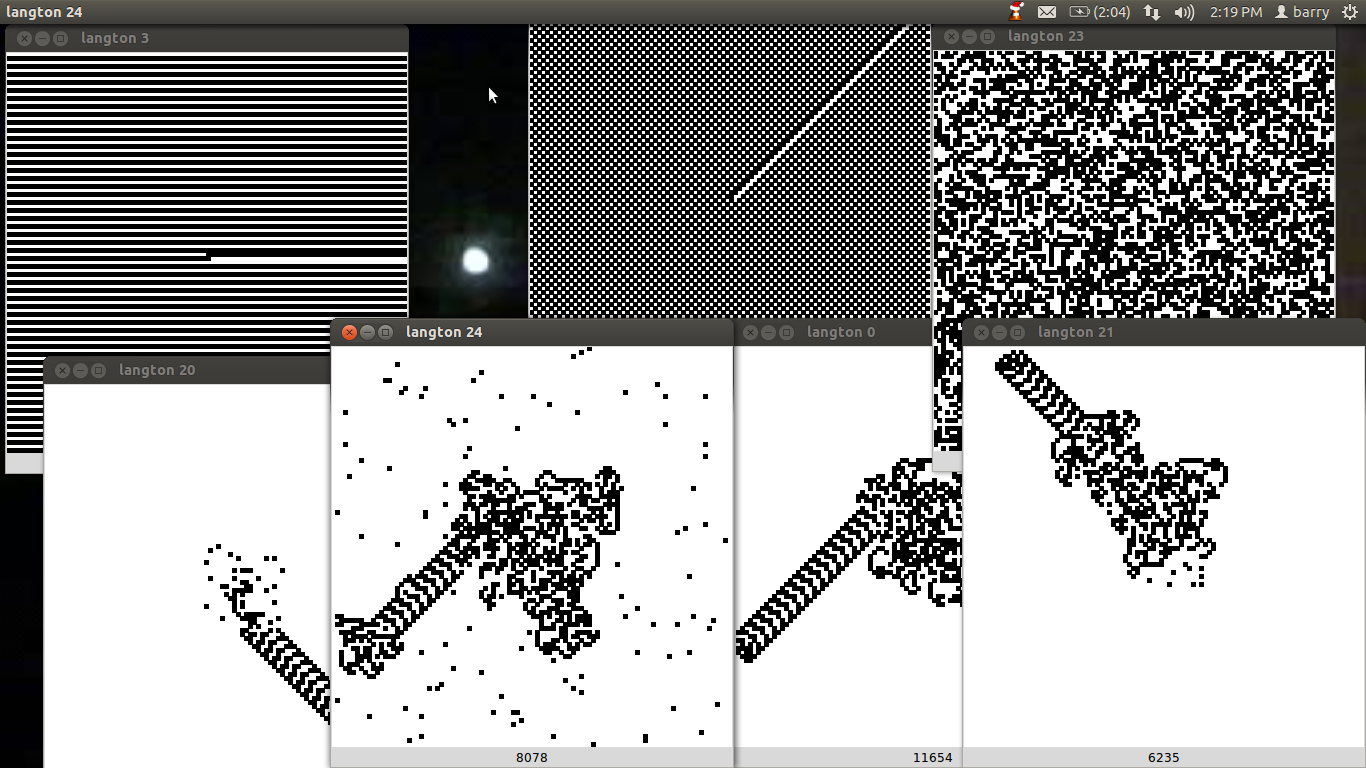
The other patterns are for other initial conditions. if i start the ant with initial random black and white squares of equal probability it wanders aimlessly faster than on all white and hits the wall rather quickly (at this point my program halts). If I start the ant with a space scattered sparsely with random black squares it tries to do the usual ant thing but keeps getting side tracked!
This is interesting. So the endless highway is not stable to perturbation. It seems it will eventually form from any initial state of a small area of randomness but any non white region larger than that small initial area can perturb it. and of course my stripe, checkerboard and total randomness initial conditions totally negate it.
I think my next step is to watch this ant on toroidal surfaces of various numbers of squares.
Subscribe to:
Posts (Atom)

